Alternative Medicines for Dermatitis Herpetiformis (Skin Disorder)
Abstract
Dermatitis herpetiformis is a skin condition that directly affects the basement membrane of skin and is an autoimmune condition. The dermis layer of skin is divided into a thin superficial area called papillary dermis and a thicker deep area, rich in thicker collagen bundles, called reticular dermis. Both the layers of dermis are composed of cellular, fibrous, and ground substance components; the latter two undergo constant synthesis and degradation. The cellular elements include fibroblasts, histiocytes, endothelial cells, pericytes and mast cells. The papillary dermis is composed of thin collagen and elastic fibres and reticulin.
On the other hand reticular dermis is composed of thick collagen bundles interspersed with elastic and reticulin fibres in a ground substance matrix. The basement membrane zone consists of the plasma membrane, the lamina lucida, the basal lamina and the sub basal lamina. In this condition the IgA is deposited below the basal lamina. In this article we will understand the pathology of dermatitis herpetiformis and will discuss it in detail.
Introduction
This is a rare condition in skin disorders that is characterized by itchy papulovesicular lesions and also there is presence of IgA at dermoepidermal junction. The age group generally affected lies between 25 to 50years of age. Even in some cases children are also seen with this condition. In a majority if we consider then dermatitis herpetiformis is noticed with presence of IgA and C3 at the dermoepidermal junction of perilesional skin. Also in addition there is evidence for activation of the alternate complement pathway. It is plausible, then, the release of chemotactic agents and the influx of inflammatory cells are responsible for the damage leading to vesicle formation. There is also a strong association between dermatitis herpetiformis and usually mild or asymptomatic gluten sensitive enteropathy which is also called celiac disease.

Causes
The condition is termed as autoimmune that means there is no specific cause for the occurrence of this condition but certain factors like radiation exposure, chemical exposure, hereditary conditions can be considered as it’s factors of occurrence. In ayurveda this condition can be understood as the result of vitiated ranjak pitta along with kapha. Thus appearance of burning blisters along with suppuration is observed.
Histology
Histologically, early changes include fibrin deposition in tips of the dermal papillae. The fully developed lesion consists of a subepidermal vesicle with neutrophils, eosinophils and lymphocytes present within or below the vesicle. Adjacent to the vesicle are characteristic microabscesses in dermal papillae, together with neutrophils and nuclear debris scattered along the dermoepidermal junction. Immunofluorescence microscopy shows IgA and C3 in a granular pattern at the dermoepidermal junction.
Clinical features
Clinically dermatitis herpetiformis is characterized by symmetrical distribution of grouped vesicles. The earliest sign of incipient eruption is marked by pruritus and burning which is followed 24 to 48 hours later by erythematous urticarial lesions.
Close inspection with the hand lens allows one to see clusters of minute vesicles surmounting the erythematous urticarial areas. Fully developed lesions are characterized by bilateral, symmetric, markedly pruritic, grouped vesicles involving shoulders, buttocks and extensor surfaces of extremities. Dermatitis herpetiformis is characterized by remissions and exacerbations.
Diagnosis
The diagnosis in this condition is done using skin biopsy. Skin biopsy is the best diagnostic technique in this condition. In skin biopsy a small sample from the affected part of skin is taken and then findings are noted during microscopy. Immunofluorescent staining shows IgA presence. The diagnosis techniques also include blood tests that show presence of IgA antibodies in blood.
Treatment
Skin lesions usually respond to oral administration of sulfonamides. Therapy with a gluten free diet is indicated in those with gastro intestinal lesions and in fact cause remission of skin lesions.
The treatment for this condition in ayurveda is very typical and involves administration of many formulations that are made using potent and effective herbs. Planet ayurveda which is a herbal manufacturing unit offers such herbal products for the management of dermatitis herpetiformis. The products offered by planet ayurveda are manufactured using really effective herbs that are mentioned in the ayurvedic classics.
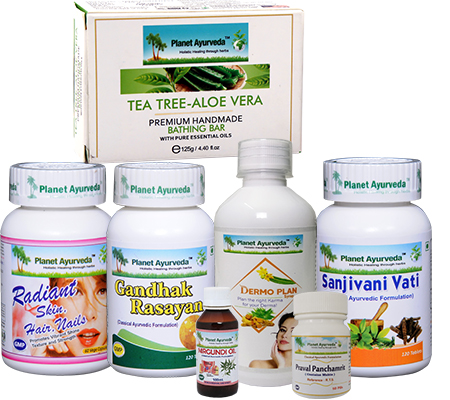

These products are as follows:
- Sanjivani vati
- Praval Panchamrit
- Gandhak Rasayan
- Radiant skin hair nails Formula
- Dermo Plan syrup
- Nirgundi oil
- Neem oil
- Tea tree- aloe vera Premium handmade bathing bar
PRODUCTS DESCRIPTION
1. Sanjivani vati
This vati is very effective and is known to infuse life. It helps in burning endotoxins present in the body. It is very effective in autoimmune conditions sas it is known to enhance immunity and increases the body’s capacity to fight disorders. This formulation consists of all the herbs that are being mentioned in the classics like sonth (Zingiber officinale), harad (Terminalia chebula), bahera (Terminalia bellerica) and many more.
Dose: Two vati twice daily after meals.
2. Praval Panchamrit
It is manufactured using many herbal components like pearl bhasma (mukta bhasma), conch shell bhasma (shankha bhasma), pearl oyster bhasma (shukti bhasma) and many more. These all herbs are a very good combination for relieving the symptoms present in this condition especially the burning sensation present around the blisters.
Dose: Two tablets twice a day after meals.
3. Gandhak Rasayan
This is a herbal supplement that helps in skin rejuvenation. It also improves the skin longevity and improves the immune system as well. It also helps in elimination of harmful toxins from the body and provides you with healthy and radiant skin. This product is formulated using a purified form of sulphur.
Dose: Two tablets two times a day after meals.
4. Radiant skin hair nails Formula
This herbal formula is manufactured using manjistha (Rubia cordifolia), pit papda (Fumaria officinalis) and many more. These all herbs help in reducing the inflammation, redness and irritation in the affected areas. The burning sensation is also relieved using these capsules as they provide you with a cooling effect.
Dose: Two capsules twice a day after meals.
5. Dermo Plan syrup
Dermo plan is very much potent to manage several skin ailments. It is a combination of herbs like giloy (Tinospora cordifolia), sariva (Hemidesmus indicus), haridra (Curcuma longa) and many more. All the herbs are potent in eliminating toxins from your body, are best for rashes, dermatitis and burning sensation on skin. The syrup is anti-inflammatory and has a little bit of analgesic effects.
Dose: Two tablespoon twice a day after meals.
6. Nirgundi oil & Neem oil
The application of nirgundi oil (virtex indigo) and neem oil (Azadirachta indica) locally is having anti inflammatory, anti bacterial, analgesic and soothing effects on skin.
How to use
You can apply both oils after mixing them and you have to apply them two times a day after meals.
7. Tea tree aloe vera Premium handmade bathing bar
This bar is having qualities of many essential oils that help in providing your skin a very soothing effect. You just have to bath with it twice a day.
Contact Planet Ayurveda to provide you the costing / ordering and delivery information at – costing.planetayurveda@gmail.com or call at +91-172-5214030 Or Check Website – www.PlanetAyurveda.com
Conclusion
Dermatitis herpetiformis is a rare condition and is of great cosmetic importance because of the involvement of skin. Such conditions are really tough to manage because of its autoimmune process. But with planet ayurveda products it can be perfectly managed and patients usually have relief in their symptoms. In case of any query you can visit www.planetayurveda.com


