Author: Dr. Vikram Chauhan

What Is Shiatsu? What Are the Benefits?

Shiatsu- massage

Abstract

Complementary treatment or additional methods of treatment are prevalent for the management of a variety of day to day problems. The complementary or alternative ways of management are ancient and are more preferred these days due to excessive side effects of synthetic medicines and approach towards more natural ways of management. These complementary ways of management were prevalent and important in day to day life as well. Shiatsu is one of the natural ways of relaxing the body, we will discuss elaborately in this article. Let’s read…

Shiatsu Massage Therapy

Introduction and History

Shiatsu is a form of massage that utilises the hands, thumb, or other body parts to apply direct pressure on various points or channels in the body. It is performed through loose clothing and oils are not meant to be used. Massage is a practice that has been present for thousands of years. Shiatsu is one of the famous and ancient massage therapies for relaxation, healing, and relief. Shiatsu is different from other massage therapies as we will discuss. Shiatsu’s origin is in Japan, it is an integrated technique of acupuncture and anma. Some physicians state Shiatsu as an advanced acupressure form. Shiatsu works to reduce the tension, pain and fatigue as it is a massage therapy involving specific body points. Also Shiatsu promotes blood circulation and strengthens the nerves as well. In the Chinese medicine system, qi is the life driving force and vital force for all activities. Shiatsu technique has roots in the qi concept. This technique says good health is a phenomenon associated with unobstructed flow of qi. The blocked or obstructed qi leads to body pain or other digestive issues, this concept is also prevalent in Ayurvedic sciences that poor status of doshas leads to health deterioration.

Basic technique

Basic technique of Shiatsu is to apply pressure. A main aim of Shiatsu practitioners is to apply pressure on parts believed to be energy channels. It will help to balance or make the flow of energy continuous. A shiatsu practitioner may also use palms, elbows, and sometimes feet to apply pressure along energy lines or paths to relieve pain and tension in the body. Before the beginning of the session a practitioner evaluates the person/patient, his/her energy and assesses a person’s state of qi (vital energy or life force) to plan the session.

The varying protocols performed by practitioners are based on the general energy level, presence of blockages, and conditions. The basic manual techniques performed by practitioners are holding, tapping, pressure, stretching, kneading, and soothing, using their thumbs, fingers, palms, and knees. Stretches, rotations, and joint mobilizations are also part of shiatsu. There is no use of oils in this famous technique of Shiatsu and no instrument is used as well. Shiatsu is a massage therapy technique practised with soft and strong pressures on the reflex points of the body. The therapist mainly exerted pressure with his thumbs and fingers—hence its name shiatsu, which means “finger pressure” in Japanese—but also with his or her palms, elbows and sometimes feet.

Benefits

  1. Improved bowel function.
  2. Decreased fatigue.
  3. Pain treatment.
  4. Improved sleep quality.
  5. Improved relaxation.
  6. Decreased depression.
  7. Headache treatment.
  8. Improvement of chronic lower back pain.

Ayurvedic techniques equivalent to  Shiatsu

Ayurveda is ancient science which is more than 3000 years old. Ayurvedic classical treatment has many branches. Panchkarma is one of the branches known for the variety of procedures having external and internal detoxification ways. We will discuss Abhyang and Marma therapy prevalent and performed by Ayurvedic physicians to manage the aggravated doshas.

Abhyang

Abhyang (massage) is a process in which body of a person is oleated with medicated oil with a special movement (gati) and specific pressure. It is done in different postures, seated with legs extended, lying on the back of the body, lying left of the body and lying on the front of body and many more. For the better results 5-10 Mins of massage therapy is used. The Nirgundi oil and Dhanwantharam oil of Planet Ayurveda is helpful in abhyang procedure due to their vata pacifying properties.

The main benefits of Abhyang are

  1. it enhances the age
  2. it helps to relieves the weakness
  3. pacify the aggravated vata dosha,
  4. Strengthen the body
  5. Promote a sound sleep
  6. Reduce the muscle stiffness.
  7. Increase the muscle strength and act as an immunity booster.

Marma Therapy

It is performed as a way to prevent the variety of health issues. Marma therapy helps to promote the blood flow to the target organs and hence reduce the chances of various fatal diseases like cancer. On the basis of classification Marma can be classified as Sadyah pranhar marma, kalantra pranahara marma, vishalyaghan, vaikalyakara marma, rujakara marma. Marma therapy promotes physical and emotional well being. Marma therapy helps to pacify the vitiated doshas even. It is evident in a variety of researches that Marma therapy is beneficial in muscular pain, joint pain, muscular strain, respiratory issues, digestion problems, confusion, anxiety and depression. Marma is helpful in various diseases like Paralysis, sciatica pain, spondylitis, respiratory issues, urinary incontinence and many more.

In Shiatsu oil is not used. But in case of severe pain Nirgundi oil and Dhanwantram oil can be used for the management of pain. Shiatsu can be used in the treatment of a wide range of internal, musculoskeletal, and emotional conditions. It is thought to reduce muscle stiffness, stimulate the skin, aid digestion, and influence the nervous system

Conclusion

Shiatsu helps to promote the person’s health by impacting the internal energy in a very positive manner. This therapy can be indicated in issues associated with Poor posture, arthritis issues, muscular pain, poor digestion and poor bowel movement, injury during sports, fever, asthma, recurrent cold, sciatica, aches and pain, inflammation joint problems such as arthritis, poor sexual health. Other mesmerising benefits are the restoration and maintenance of energy and maintaining the body’s energy. Also it is beneficial to improve circulation, help to reduce stress and promote healing from injuries. The best thing about this technique is that it is non-invasive therapy to deal with diseases. Like Ayurveda techniques the shiatsu is also considered safe under the guidance of trained practitioners.
Alternative Ayurvedic Treatment For Phytophotodermatitis

Abstract

Dermatitis is a common condition that can occur due to many causes. Dermatitis is a word to describe a number of skin inflammatory conditions. Dermatitis can result in rashes, blisters, dry skin, hyper or hypopigmentation, itching, flakes, and oozing. Phytophotodermatitis is one among these skin inflammatory conditions. Phytodermatitis is an inflammatory condition that can result from an excessive response to a chemical. This condition is quite disturbing and discomforting. We shall discuss the condition of photodermatitis in detail along with its management in the contemporary system of medicine as well as in the Ayurvedic system of medicine. Let’s discuss it!! 

Phytophotodermatitis

Introduction

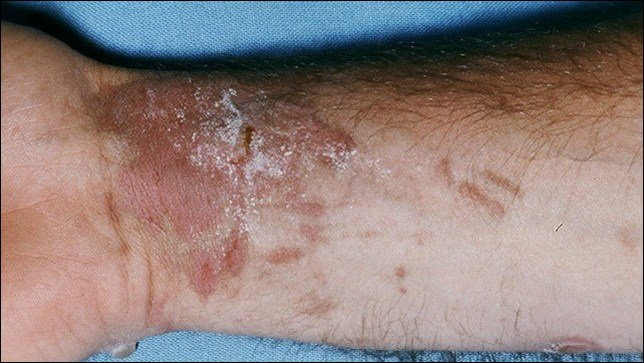
Phytophotodermatitis can be understood by splitting its words – phyto stands for plants, photo stands for ultraviolet radiation of the sun and dermatitis denotes skin inflammation. So by adding all of these it suggests that phytophotodermatitis is an inflammatory skin condition that results from the reaction of the skin when come in contact with some plant chemical and then exposed to the sunlight. 

Phytophotodermatitis is also known as breloque dermatitis or margarita photodermatitis. These chemicals are known as furocoumarins. These chemicals are found in some of the plant families. And exposure or contact with these chemicals results in inflamed and irritated skin. In Ayurveda, the condition can be understood with the rakta and pitta dosha dushti due to aagantuj reason. Now let’s see the causes, classification, features, management, and Ayurvedic aspect of the condition.  

Causes of Phytophotodermatitis 

  • Phytophotodermatitis is a condition that comes from certain plant chemicals which belong to the families – Apiaceae, Rutaceae, Moraceae, and Fabaceae. 
  • Sunlight
  • Ultraviolet rays 

Signs and symptoms

  • Usually, the reaction starts within twenty-four hours after exposure, and the condition peaks on the second to the third day. 
  • Erythema
  • Edema
  • Large blisters (vesicles or bullae)
  • Delayed hyperpigmentation
  • Heat and moisture aggravate the condition
  • Eye exposure to the agent can result in temporary to permanent blindness

Investigations

Physical examination and proper history taking.are necessary things that make the diagnosis easier. 

Differential diagnosis 

  • Hives (Urticaria)
  • Skin infections

Prevention

  • Avoid contact with the plants of above said families and other agents that are regarded to have phototoxic reactions. 
  • In places, where contact with such phototoxic agents is inevitable then wearing long clothes that properly cover the skin, is necessary. Handling of such plants should be performed only after wearing proper gloves and eye guards.
  • Applying sunscreen is a must thing to do.
  • Washing clothes and skin after getting in contact with these phototoxic agents.
  • Do not go out if it is not necessary. 

Management

  • Anti-histamines
  • Anti-inflammatory
  • Skin whitening agents
  • Sunscreen lotions

Ayurvedic Aspect and Management of Phytophotodermatitis  

Ayurveda is a traditional medicinal system of the Indian subcontinent which has been serving humanity from old ages. And till today its concepts are rational, valid and fruitful, and result-oriented. There are various skin conditions mentioned in the Ayurvedic texts which usually result from the pitta and rakta dushti. This condition of phytophotodermatitis which is an inflammatory skin condition that can be best correlated with the Aagantuj reasons (foriegn reasons) which vitiates the rakta and pitta (bhrajaka pitta) duhti. This is a dushti due to nisaar janya aagntuj nidan. There is no proper Ayurvedic term for this condition but the condition can be well understood how and which dosha gets vitiated as we saw above. Furthermore, this results in pidika (blister), kandu (itching), shotha (inflammation), vyanga (hyperpigmentation) at the placer post-blister. These symptoms get worse after exposure to sunlight or UV rays. 

The management protocol depends on soothing and cooling the skin and pacifying the rakta and pitta dushti. There are a number of herbs that beautifully manage the rakta and pitta dushti. The herbs include Chandan (Santalum album), manjishtha (Rubia cordifolia), neem (Azadirachta indica), sariva (Hemidesmus indicus), kumari (Aloe barbadensis), khadir (Areca catechu), haridra (Curcuma longa) and various others. Some of the various ayurvedic formulation which helps in phytophotodermatitis is gandhak rasayan, mahamanjisthadi kwath, khadirarishta, panch tikta ghrita guggulu, sarivadyarishta, chyawanprash, etc.

Herbal Remedies for Phytophotodermatitis by Planet Ayurveda

Planet Ayurveda is an eminent GMP-certified, ISO 9001:2015 certified and US-FDA registered Ayurvedic Company, which adheres to the objective of manufacturing quality Ayurvedic products as mentioned in a number of ancient texts of Ayurveda. Formulations are manufactured without additives and preservatives and other kinds of chemicals or artificial flavoring agents which can have a number of side effects on the human body. Products manufactured at Planet Ayurveda are pure and devoid of any kind of adulteration. The products are purely organic, vegetarian, gluten-free, and halal-certified. Planet Ayurveda presents its product that effectively manages the condition of Phytophotodermatitis.

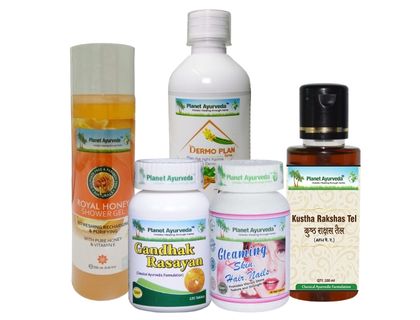
Following is the list of formulations that are helpful in managing Phytophotodermatitis

Product List

1.  Gleaming Skin Hair Nails Formula 

2.  Gandhak Rasayan

3.  Kustha Rakshas Tel

4.  Royal Honey Shower Gel

5.  Dermo Plan Syrup

Herbal Remedies For Phytophotodermatitis

Herbal Remedies For Phytophotodermatitis

Product Description

1.  Gleaming Skin Hair Nails Formula 

Gleaming Skin Hair Nails Formula is a product of Planet Ayurveda that is composed of standardized extracts of the herbs like manjistha (Rubia cordifolia), pit pada (Fumaria officinalis), sariva (Hemidesmus indicus) and kumari (Aloe barbadensis). It pacifies the pitta dosha and does rakta shodhana (blood purification). With its blood-cleansing properties, it rectifies the pitta and rakta dusti hence helping in overcoming this discomforting condition of phytophotodermatitis.

Dosage:  One capsule twice daily with plain water after meals.

2.  Gandhak Rasayan

Gandhak Rasayan is a classical formulation in tablet form and contains shuddha gandhak (purified sulfur). Gandhak Rasayan benefits the body in a number of conditions. It reduces fever, treats skin conditions such as rashes and blisters, and acts as a potent antimicrobial, antiviral, antibacterial, anti-inflammatory, anthelmintic, antioxidant, and antipyretic agent. With all these properties Gandhak Rasayan is beneficial in phytophotodermatitis as it reduces rashes and inflammation of the skin through its anti-inflammatory properties. And also soothes the skin and provides a healthy skin. 

Dosage:  Two tablets twice daily with plain water after meals.

3.  Kustha Rakshas Tel

Kustha Rakshas Tel is a classical ayurvedic formula action that has been in use for managing a number of skin disorders such as dermatitis, leprosy, itching, inflammation, etc. the ayurvedic oil is made up of reasons (Allium sativum), bakuchi (Psoralea corylifolia), aragwadha (Cassia fistula), shuddha parada (purified mercury), shuddha gandhak (purified sulfur), rasa sindoor (combination of mercury and sulfur), Tamra bhasma (calcined copper), manahshila (arsenic sulfide) and mustard oil. With its skin-soothing properties and anti-inflammatory action it is best used in phytophotodermatitis. 

Dosage:  Wash the affected area with some mild herbal soap or shower gel and apply this oil at least 2 – 3 times a day.

4.  Royal Honey Shower Gel

Royal Honey Shower Gel is a herbal shower gel prepared by Planet Ayurveda. It is a gel prepared with honey, aloe vera (Aloe barbadensis), tea tree extract (Melaleuca alternifolia), and other things. The shower gel soothes and cools the skin thus helpful in managing the itching, rashes, and other symptoms caused by phytophotodermatitis with its antibacterial, anti-inflammatory, and other skin-benefitting properties. 

Dosage:  Take a few drops of shower over the wet lofa and with the help of it apply it over the skin gently and make leather. After that rinse it with water.

5.  Dermo Plan Syrup

Dermo Plan Syrup is a polyherbal product of Planet Ayurveda that provides skin wellness. The syrup contains the extract of the herbs including manjistha (Rubia cordifolia), giloy (Tinospora cordifolia), chopchini (Smilax china), sariva (Hemidesmus indicus), neem (Azadirachta indica), khadi (Areca catechu), Haridra (Curcuma longa), shobhanjan (Moringa oleifera), gorakhmundi (Sphaeranthus indicus) and others. The verbs are known to be varna (promotes skin lightening), blood purifying, and pitta pacification properties. With these wonderful properties, the syrup is the best remedy to manage phytophotodermatitis. 

Dosage:  Two tsp twice daily with plain water after meals. 

CONTACT  PLANET AYURVEDA  TO PROVIDE YOU WITH THE    COSTING / ORDERING AND DELIVERY INFORMATION AT – COSTING.PLANETAYURVEDA@GMAIL.COM OR CALL AT +91-172-5214040

Conclusion 

Phytophotodermatitis is a type of skin inflammation, particularly contact dermatitis. The condition occurs due to contact with certain plant chemicals that cause inflammation, blister, rashes, and itching at the site of the contact followed by exposure to sunlight or ultraviolet rays. These chemicals are known as furocoumarins, which are present in some plant fancy families. One can prevent the condition by following some preventive measures as we discussed above. In the modern system of medicine, there are antihistamines and anti-inflammatory medicines are used that suppress the symptoms super soon but hurt in another way of side effects. Whereas, Ayurveda offers a good management protocol that rectifies the vitiated pitta and rakta dosha which eventually helps the management of the condition and enhances the beauty of the skin, providing good and healthy skin free of diseases. Hence Ayurveda manages skin disorders more efficiently than any other system. The products mentioned above provide good results in the condition of phytophotodermatitis. Choosing Ayurveda !! Choose healthy skin !!