Fragile X Syndrome (Martin-Bell syndrome)-Treatment in Ayurveda
Abstract
Genetic disorders are the disorders that occur due to changes or mutation in the genes. These mutations occur at the time of conception. There are many disorders that fall in the category of genetic disorders. Further in the scenario comes the developmental disorders that may result due to poor nutrition intake by mother lead to hampered development of the bodily organs. Hence when such an underdeveloped organ’s child is born then some unwanted and unavoidable things happen that affect the life standard of that person drastically. In other words, the person becomes dependent on others. These changes can alter the life from mild to severe depending on the degree of development error. In the text below, we are going to discuss one such condition namely Fragile X Syndrome. Let’s get started !!
Introduction
Fragile X Syndrome is a genetic disorder that results in a number of developmental problems including learning incapacities, cognitive impairment and mental debilitation. Typically, males are more seriously affected by this condition than females. The condition is named as Escalante syndrome. Fragile X Syndrome causes a lot of symptoms other than the neurological ones. The face features are also layered than the normal one. The Fragile X Syndrome occurs in approximately 1 in 4000 males and 1 in 8000 females. In Ayurveda, the condition can be correlated with beej dushti by the vitiated vata dosha. We will look deep into the Ayurvedic aspect of the same. For now let’s have a look at the causes, signs, symptoms, investigations and management of Fragile X Syndrome !!
Causes of Fragile X Syndrome
Mutations in the FMR1 gene cause fragile X syndrome. This FMR1 gene gives directions to making a protein called FMRP. Thus protein manages the production of different proteins and assumes a part in the development of synapses which are specific associations between nerve cells. Neural connections or synapses are basic for relaying impulses.
The DNA segment, called as CGG triplet repeat. Generally this segment is repeated from five to forty times but in Fragile X Syndrome this is repeated more than two hundred times. This abnormal expansion of the CGG segment silences the FMR1 gene that hampers the production of FMRP. Shortage of the protein results in various abnormal functioning of the nervous system and signs and symptoms of fragile X syndrome appear.
Signs and symptoms
Younger ones do not show any physical signs or symptoms of fragile X syndrome. The physical features do not appear until puberty.
Physical appearance
- Long face
- High arched palate
- Flat feet
- Hyperextensible finger joints
- Hyperextensible thumbs
- Soft skin
- Hypotonia
- Large and protruding ears
- Post Pubescent macroorchidism
Intellectuality
Intelligent quotient can vary from normal to severely disabled with an average 40 IQ in males with total silencing of the FMR1 gene. Females who are not affected much as compared to males have generally normal levels of IQ. The main problems that a person with fragile X syndrome faces short term memory, visual memory, mathematics, visual spatial relationships and executive function.
Autism
In many cases, Fragile X Syndrome coexists with autism and it is one of the suspected genetic causes of autism.
Genetic mouse models of fragile X syndrome have also presented to behaviour like autism.
Social interaction
Fragile X Syndrome is characterised by poor eye contact, prolonged time to interact with people, difficult and prolonged challenges forming peer relationships, gaze aversion and social anxiety. Excessive shyness, panic attacks.
Mental health
Majority of males and thirty percent females suffering from Fragile X Syndrome have Attention deficit hyperactivity disorder (ADHD). Children suffering with fragile X syndrome are hyperactive, have a very short attention span, and are hypersensitive to tactile, auditory, olfactory and visual stimuli. Preservation is one of the common behavioural and communicative symptoms of fragile X syndrome. Overdoing or repeatedly doing an activity.
Persons with fragile X syndrome experience mood disorders, anxiety issues, and dementia.
Ophthalmologic symptoms
Strabismus is one of the ophthalmological manifestations of fragile X syndrome. Amblyopia and refractive errors are common is fragile X syndrome.
Neurological symptoms
Seizures, tremors and loss of coordination is seen in the persons suffering with Fragile X Syndrome.
Fertility and working memory
Fertility and working memory in persons with fragile X syndrome is severely hampered.
Investigations
-
- Polymerase chain reactions (PCR)
- Southern blot
- Prenatal testing with chorionic villus
sampling or amniocentesis appears to be reliable.
Management
- Symptomatic management is done with much use of stimulants that manages impulsivity, attentional problems and hyperactivity.
- Underlying anxiety, depression, obsessive compulsive behaviours and mood disorders are managed with antidepressants such as selective serotonin reuptake inhibitors (SSRIs)
- To manage aggression, aberrant and self injurious behaviours are managed by antipsychotics.
- Seizures and mood swings are managed by anticonvulsants.
Ayurvedic Aspect of Fragile X Syndrome and its Management
Ayurveda is a traditional medicinal system of India. Ayurveda has been serving mankind since ages and the principles of Ayurveda are still valid till date. Ayurveda is based on the three doshas (energies) vata, pitta and kapha. Theses within the normal range pronounced as health wheres any imbalance is regarded as a state of a disease. Furthermore Ayurveda focuses on the way of life or type of lifestyle. As Ayurveda considers the sedentary lifestyle a root cause of various diseases. Ayurveda has mentioned about the anuvanshik roga (genetic disorders).
In the case of Fragile X Syndrome, the Ayurvedic concept of beej dushti comes out to be the perfect correlation. When the shonit (ovum) and shukra (sperm) get vitiated by any or two or all three dosha at the time of fertilisation, then it gives rise to the establishment of the dusht beej that in later life results in the diseased or abnormal child. This is the best correlation that can be well established with Fragile X Syndrome.
As the basic structure of a person or the beej dushti cannot be reversed. Therefore, the management of Fragile x Syndrome becomes completely symptomatic. The symptoms of the condition can be well managed with the Ayurvedic medicines with the dosha pacification properties. Generally the symptoms that appear in fragile X syndrome are due to vata imbalance. The management thus depends on balancing the vata dosha and other associated dosha involvement.
Certain medications such as vat vidhwansan ras, vrihat vatchintamani ras, vat gajankush ras, haridra khand, ras sindoor, brahmi vati, shankhpushpi powder, yashthimadhu ghan vati, ashwagandharishta, kumar kalyan ras etc are helpful in managing fragile X syndrome up to a desired level.
Herbal Remedies by Planet Ayurveda for Fragile X Syndrome
Planet Ayurveda is an eminent ISO 9001:2015, USA-FDA, GMP certified ayurvedic company. Planet Ayurveda looks forward to spreading the wisdom of Ayurveda on the Planet Earth. Planet Ayurveda formulates formulations that are available in various forms such as tablets (vati), capsules, jams (avleha/prash), powders (churna), syrups (asavarishta/ark/saar). The products of Planet Ayurveda are pure and do not contain the harmful chemicals. Products are not mixed with additives and flavour enhancers. Planet Ayurveda’s products are halal certified and gluten free. Planet Ayurveda extends its products for the management of Fragile X syndrome.
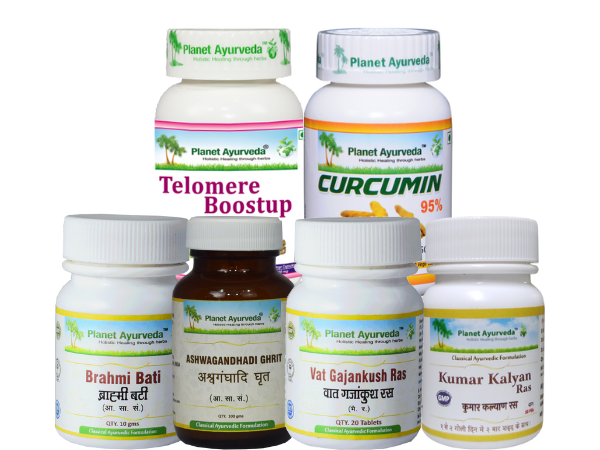
Following are the products of Planet Ayurveda that are helpful in managing Fragile X Syndrome
- Ashwagandhadi Ghrit
- Kumar Kalyan Ras
- Telomere Boostup
- Brahmi Vati Gold
- Vat Gajankush Ras
- Curcumin 95% Capsules

Product description
1. ASHWAGANDHADI GHRIT
Ashwagandhadi Ghrit is one of the classical ayurvedic formulations used to manage a number of conditions. Ashwagandhadi Ghrit is composed of ashwagandha (Withania somnifera), bibhitaki (Terminalia bellirica), cow’s ghee (clarified butter) and cow milk. Ashwagandha is regarded as rasayana. Therefore, Ashwagandha helps in a variety of conditions from general debility to chronic conditions. Ashwagandha pacifies the vata dosha and thus improves functioning of the neurological disorders. Ashwagandhadi Ghrit manages symptoms of Fragile X Syndrome very well with its antiepileptic, antipsychotic, anticonvulsant and antidepressant activities.
Dosage: Half tsp twice daily
2. KUMAR KALYAN RAS
Kumar Kalyan Ras is a classical herbomineral formulation that is used in a very large variety of disorders. Kumar Kalyan Ras is made up of kumari rasa (Aloe vera juice), ras sindoor (purified mercury), mukta bhasma (pearl calx), swarna bhasma (gold calx), abhrak bhasma (mica calx) and various others. Kumar Kalyan Ras works as an elixir in paediatric disorders. It helps in various disorders of children and multiplies the potency of the other medicines with which it is taken. Kumar Kalyan Ras pacifies the pitta dosha which helps in coping up with impulsivity, hyperactivity and aggression of Fragile X Syndrome.
Dosage: One tablet twice daily
3. TELOMERE BOOSTUP
Telomere Boostup is a patent product of Planet Ayurveda. Telomere Boostup is filled with the energy providing an immunity building properties of ashwagandha (Withania somnifera), grapeseed (Vitis vinifera), amla (Emblica officinalis), moringa (Commiphora mukul) and giloy (Tinospora cordifolia). All these herbs boost immunity and aid proper spermatogenesis and oogenesis and prevent further passing on the affected genes to the offspring. Furthermore, it helps in overall mental and physical soundness of a person with Fragile X Syndrome.
Dosage: One capsule twice daily.
4. BRAHMI VATI GOLD
Brahmi Vati Gold is a classical herbomineral formulation that is used for a wide variety of psychological, psychiatric and neurological disorders. Brahmi vati is composed of different herbs such as brahmi (Bacopa monnieri), vacha (Acorus calamus), swarna bhasma (calx of gold) etc. The ingredients of the formulation are very effective in the management of various vata and pitta disorders. As depression, suicidal thoughts, self harm, mania, aggression, tremors, seizures etc are due to vata and pitta related, Brahmi vati Gold is perfect remedy to manage all these very well. Therefore, Brahmi Vati Gold is one of the finest remedies for Fragile X Syndrome.
Dosage: One tablet once daily.
5. VAT GAJANKUSH RAS
Vat Gajankush Ras is a classical herbomineral formulation that is extensively used in vat disorders and vata and kapha symptoms. Vat Gajankush Ras is made up of shudha parada (purified mercury), loha bhasma (Calx of Iron), makshik bhasma (Calx of iron pyrite and copper), shudha gandhak (purified sulphur), black pepper (Piper nigrum), long pepper (Piper longum), shunthi (Zingiber officinale) and various other herbs and minerals. Vat Gajankush Ras is a well known remedy for vata disorders. Psychosis and depression are due to vata vitiation and the condition is thus required to be managed by vat pacification and there is no better remedy than Vat Gajankush Ras.
Dosage: One tablet twice daily
6. CURCUMIN 95% CAPSULES
Curcumin 95% capsules are a patent product of Planet Ayurveda. Curcumin 95% capsules contain pure herbal extract of haridra (Curcuma longa). Turmeric being a vata dosha balancer helps in the healthy functioning of the nervous system. Haridra is used to calm the mind and results in well being of mental health. As it balances the vata dosha, it is of great use in the management of mental illnesses like depression and anxiety lead by Fragile X Syndrome.
Dosage: One capsule twice a day.
Contact Planet Ayurveda Support Team to provide you the costing / ordering and delivery information at – costing.planetayurveda@gmail.com or Call at 0172-521-4030 (India), +91-172-521-4030 (Outside India) or Whatsapp at (+91) 9915-593-604
Conclusion
Fragile X Syndrome is a genetic disorder that makes a person (child) physically abnormal and mentally disabled. This is a threatening condition that occurs due to over repetition of segment CGG that silences the FMR1 gene and the condition progresses and hampers the intellectuality of a person. Amid the intellectual abnormality the physical appearance of the affected person is also deranged as the silencing of FMR1 gene results in the hampering of the protein FMRP and other proteins as well. Hence the condition is disabling.
The management of the condition is generally symptomatic and the modern medicines are quite toxic and hampers the functioning of other healthy organs and the condition can be seriously deteriorated. Whereas the Ayurvedic medicines check the intellectuality levels and uplift it. And the prevent the tremors and epilepsy attacks with vata balancing properties and with their pitta balancing properties they effectively mangoes the aggression and self harm or suicidal thoughts without any side effects on the body. Hence the herbal or Ayurvedic management of Fragile X Syndrome seems positive and devoid of any side effects.