Ayurvedic Remedies for Liver Failure? How are These Better to the General Medicines?
ABSTRACT
As quoted by an American philosopher William James that “Is life worth living? It all depends on the liver”. It perfectly explains the importance of liver. Liver is one of the most important organs and taking care of it must be our priority.
Nowadays, due to sedentary lifestyle and increasing trend of packed food items and the polluted environment results in various ailments which affect our liver the most. Various modern medicine that the person take for long duration including anti-diabetic drugs, anti-hypertensive drugs and all the steroids and immunosuppressants and drugs with hepatotoxic side effects. They, in turn, cause hazardous effects on our liver which leads to inflammation of liver slowly or gradually progressing to liver fibrosis followed by liver cirrhosis, thus resulting in complete loss of liver functioning i.e., liver failure. But in contrast to Modern medicine, Ayurveda uses lifestyle modification methods which include both Aahar (dietary changes) and Vihaar (physical activities) along with some detoxification methods and medicines which are herbal or herbo-mineral in origin, time-tested and are used in purified form as mentioned in the ancient text by Acharyas. These medicines have lesser side effects and much more therapeutic value than Modern medicine.
Let’s discuss these facts in detail and know how the person of liver failure can be treated better in Ayurveda?
INTRODUCTION
Liver Failure generally means gradual loss of all the functions that are performed by the liver and is considered as a complication of various liver related disorders rather than a separate disease. There are numerous types of liver diseases. But in the end, damage to the liver is likely to go on the same progression route. Whether the liver is infected with a virus, or autoimmune, chemical injury, in nutshell, the danger is the same – which ends up in liver failure. Liver cirrhosis, liver carcinoma, and liver failure are serious conditions that are life threatening. Once the person reaches these stages of liver disease, the treatment options get very limited i.e. use of immunosuppressant drugs, steroids and in later stages liver transplant (partial or complete) is left as an only option, which in turn has its very dramatic consequences.
In Ayurveda, as there is no specific explanation for liver failure, so we can take liver failure as an updrava (complication) of all the yakrit rogas (liver disorder) which ranges from kamala (jaundice), kumbhkamala (ascites due to jaundice/liver cause), halimak (green texture in stool; a complication of kamla), yakrit vidradhi (hydatid cyst), yakrit vridhi (hepatomegaly), yakridalodar (cirrhosis of liver), yakritarbud (tumors of liver) and other yakrit rogas.
Some Interesting Facts About Healthy Liver
- The liver helps in clarifying various toxins and thus fights infections and cleans the blood.
- The liver also helps in food digestion and even acts as a storehouse of energy for emergency situations.
- A healthy liver has the ability to regenerate itself if damaged, this property is rarely seen in any other body organ.
About Ayurveda
Ayurveda as a Science of life is focused on keeping the health of a healthy person intact and then is focused on how to treat the diseased person. Ayurveda is not only focused on treating the ailment with medicines, despite that the person had to follow a proper daily and seasonal regimen according to one’s prakriti. These regimens include various modifications in diet and lifestyle. Lifestyle modifications include waking up habits, sadvrit (good moral behaviors), doing yogasana & pranayama daily, brisk walking, and getting indulge in physical activities.
Let’s Discuss This in Detail.
General approach towards a person with Liver disorder in Ayurveda
The person having liver disorder must be examined on the basis of rog and rogi pariksha as mentioned our texts by Acharyas
- Roga Pariksha includes the Nidana Panchak which helps in evaluating the stage and severity of the disease. These contains
- Nidana also known as Hetu, are the causative factors or risk factors responsible for the origin or progression of the disease. For instance, as discussed above liver disorders are more prevalent because of the over use of packed food items/ unhygienic diet regimen, uncontrolled abuse of alcoholic products and the increasing trend of this sedentary lifestyle & lack of physical activity.
- Poorvaroop means the prodromal symptoms (pre-clinical symptoms) are the initial indications that the disease is going to manifest soon. This stage is perfect for the treatment, in case of liver failure, hepatitis (inflammation of liver), or jaundice are considered as prodromal symptoms. Treating well at that stage with some alteration in lifestyle, and just by avoiding the Nidana sevan, the person can get rid of various liver disorders.
- Roop means the stage of the disease in which the signs and symptoms of the disease begin to manifest. This stage manifests when the person continue Nidana sevan (i.e. Taking/doing the causative/ risk factors). This is the perfect stage for disease to be well diagnosed and treated accordingly.
- Upshaya means therapeutic test, in some cases where it is difficult to reach a conclusion and make a diagnosis of the disease that disease is checked on the basis of Upshaya-anupshaya. On the basis of the effects of Aushad, Aan & Vihar in particular, whether it is helpful or not, the treatment plan is decided.
- Samprapti means Pathogenesis of the disease. It is the process which explains how after various Nidana sevan, the vitiated dosha affects the individual & causes various diseases. It is the most important step in making a proper diagnosis of the disease and thus is an important tool in the treatment as Samprapti-vighatan (breakage in the link of samprati at various levels) is known as Chikitsa (treatment).
These are the five tools to access the extent and severity of the disease. Now Acharyas had also mentioned various examination methods i.e. parikhas to evaluate the diseased person.
Rogi Pariksha:-After roga pariksha (evaluation of the disease), the Rogi pariksha is done. In context of Rogi Pariksha Acharyas had described various Pariksha vidhis that includes
1. Dwibidh Pariksha:-a). Pratyaksha (Inspection) b). Anumaan (Assumption)
2. Tribidh Pariksha:-a). Pratyaksha b). Anumaan c). Aaptopadesh (as written in Samhitas by Acharyas)
a). Darshan (Inspection) b). Sparshan (Palpation) c). Prashan (Interrogation)
3. Chaturvidh Pariksha :- a). Prataksha b). Anumaan c). Aptopdesh d). Yukti
4. Panchvidh Pariksha:-Panchgyanindriya pariksha (examination of five senses i.e. sense of hearing, sense of touch, sense of vision, sense of taste and sense of smell
5. Shadvidh Pariksha: -Panchgyanindriya Pariksha and Prashan pariksha.
6. Astvidh Pariksha.
7. Dashvidh Pariksha.
Let’s discuss the Dashvidh Pariksh a given by Acharya Charka in Charka Vimaansthana, 8
This include
1. Prakriti Pariksha
The correct evaluation of a patient’s prakriti is the first step towards rogi pariksha. This pariksha includes evaluation of both physical & mental nature (manas & dehik prakriti). It will help in understanding the patient’s nature, making diagnosis, evaluating prognosis of disease, some clue about his Agni (digestive power) & thus accordingly can decide the diet & treatment plan that best suits the patient.
2. Vikriti Pariksha
Acharya Charka had guided Vikriti Pariksha by dosh-dushya-prakriti-desh-kaal-bal-agni etc. These tools will help in making a good diagnosis of the disease.
3. Saar Pariksha
The word “Saar” refers to the purest form of Rasadi dhatus. Saar pariksha is important in accessing the correct knowledge about a patient’s strength and age.
4. Sehnan Pariksha
Sehnan referred to the composition. Sehnan Pariksha here is the diagnostic tool to evaluate the patient’s physical construction & compactness e.g. Patient is sthool (obese), krish (feeble), madhyam shirr (healthy body).
5. Parman Pariksha
This Pariksha deals with the measuring of body parts of patients. Parman pariksha is described to be taken with Anguli parman in ancient era. But nowadays, we can correlate it with weight of body, height of person etc.
6. Satmaya Pariksha
The food- medicine, dietary-physical habits & the place of residence due to regular utility had become favorable & comfortable for the person is known as Satmya for that person. On the basis of Pravar, avar and madhyam this pariksha is divided into 3 types.
7. Sattva Pariksha
Satva refers to mental strength. It is also divided into three subtypes i.e. Pravar, Madhyam and Avar sattva.
8. Aahar Shakti Pariksha
It is the most important tool in diagnosis of a patient as it is the method to evaluate the patient’s Agni (digestive power). This is done in two steps i.e. Abhyaran Shakti (ability of person to eat) and Jaran Shakti (ability of person to digest).
9. Vyayam Shakti Pariksha
By accessing the Vyayam Shakti the person will get an idea about the person’s physical strength. It will help the Physician to decide the potency of a drug that can be used for the patient according to physical strength of the person.
10. Vaya Pariksha
Vaya means age, Age plays an important role in diagnosis as well as in deciding treatment plans. The age is divided into mainly 3 subgroups
- Balyaavastha (Childhood i.e. from birth to 30 years)
- Madhyamavastha (30-60 years of age)
- Jeernavastha (61-100 years of age).
Thus, by using these 10 diagnostic tools on the patient, the physician will get a broad idea about the patient and his/her illness and he can very well decide the treatment, dietary & lifestyle modification plans accordingly.
CHIKITSA (TREATMENT)
As already discussed above the Samprapti vighatan (breakdown of pathogenesis at different levels) is known as Chikitsa. So, the first step towards treatment should be Nidana parivarjan i.e. avoidance of the possible causative/risk factors. In this disease, these include Ahitkar Aahar-vihar. Apart from this treatment methods include
- Shodhan Chikitsa
- Shaman Chikitsa
- Pathya Apathya Aahar
- Yoga asana & Pranayam
1. Shodhan chikitsa
(Detoxification Method) can be used on patients with Pravar Satva and Pravar Vyayam Shakti (i.e. in person having well mental & physical built). Virecahan & Basti are the best choice for Shodhan Chikitsa here and that too varies from patient to patient.
2. Shaman Chikitsa
These contain various herbal/herbomineral preparation mentioned in the texts. Those drugs include mostly the herbs which are hepato-protective in actions or immune modulator drugs.
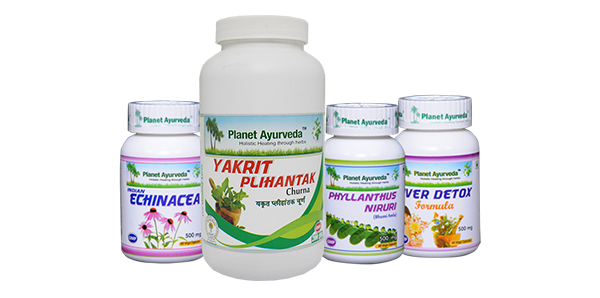
Planet Ayurveda offers 3 liver care packs that include herbal drugs made from the classical references and are strictly under our experts’ guidance. These herbs/mineral formulations are obtained from natural sources and are prepared under proper ancient time tested formulas.
One of the Liver Care Pack, as created by our experts as per their experience and in adherence to the Ayurvedic text, is discussed below:
- Liver Detox Capsules
- Echinacea Capsules
- Yakritplihantak Churna
- Phyllanthus Niruri
 PRODUCT DESCRIPTION
1. Liver Detox Capsule
It is a poly herbal formulation available in capsule form. It contains Katuki (Picrorhiza kurroa), Kalmegh (Andrographis paniculata), Haritaki (Terminalia chebula) etc. Katuki is the best drug used for bhedan karma (these groups of drugs irritate the small intestine and break the toxins deposited in it) and then the drugs like haritaki in it, do the purgation effect. Thus, this combination of drugs help in better detoxification of the body, which will decrease the excessive load on the liver and thus the other medicines can have better effects.
Dosage-1-2 twice daily with plain water, after meals
2. Echinacea Capsules
It is a single herb formulation in capsule form. The basic ingredient/ source of this drug is Indian Echinacea. In Ayurveda, this drug is known as Kalmegha (Andrographis paniculata). Kalmegha is well known for its hepato-protective and anti-inflammatory abilities. It protects the hepatocytes from free radicals by scavenging them due to its antioxidant property. It also acts as a natural immunity booster. So, it can be very effective in the Treatment of Liver failure patients.
Dosage: 1-2 Capsules twice daily, with plain water, after meals.
3. Yakritplihantak Churna
It is a classical drug indicated for numerous spleen & liver related disorders & is available in powder form. Few of the ingredients include Makoy (Solanum indicum), Bhumi amla (Phyllanthus niruri) and other drugs in this churna that have specific role in keeping the liver healthy, thus they can treat various liver related disorders.
Dosage: 1/2 to 1 teaspoonful twice daily, with plain water or fruit juice, after meals.
4. Phyllanthus Niruri
It is also a single herb preparation which is available in capsule form. It is a well-known classical herb under the name of Bhumi Amla or amalaki. It contains the standardized extract of Phyllanthus niruri. The drug is considered as one of the best in hepato-protective activity by improving hepatic regeneration. By enhancing IgG antibodies it can also act as immunomodulatory. Thus, this wonderful drug can be greatly utilized in the treatment of liver failure patients.
Dosage: 2 capsules twice daily after meals.
Pathya-Apathya(Do’s and Don’ts)
As a Science of Life, Ayurveda does not only focus on medicines to keep a person free from ailments but also the diet and lifestyle as already discussed above. These are known as Aharaj & Viharaj alterations in Ayurveda. Acharyas had given various do’s and don’ts that are called as pathya-apathya. Here are some pathya-apathya for Liver failure patient
- PATHYA AHARA:-The dietary habits\food items best suited for liver failure patients.
- Fresh vegetables:-Green leafy vegetables are the best suited for a healthy liver as it contain the magic molecule i.e. Nitrous oxide promotes health by aiding in regeneration of the damaged part of the liver and thus helps in recovering the liver patient. These also contain a variety of vitamins and totally are nutritious food.
- Salad:-Salad must be included in the liver patient’s diet. The quantity of salad in total food (lunch or dinner) must be at least 25%. The salad is to be consumed before the meal.
- Smoothie:-Herbal smoothie made from the leaves & fresh fruits must be prepared fresh daily and consumed by the patient slowly.
- Fruits:-Fruits must be consumed in adequate quantity. As they contain all the nutrition required for a person to remain healthy. Fruits must be consumed fresh or freshly prepared juice can be drunk. Coconut water and Pumpkin juice are very useful.
- Dry fruits:-Use of dry fruits is very much advisable to these patients. Some of the best dry fruits include Cashew nut, almonds, walnut, resins etc. These dry fruits must be soaked in water for some time & are peeled off before use. These are easy to carry as an emergency source of energy i.e. whenever the patient feels hungry he/she can take them conveniently.
- Millets:-Use of millets is highly advisable to these patients instead of traditionally used grains i.e. wheat or rice. Barnyard millets are the choice of grains for liver disorders. Millets must be started in the form of Khammer i.e. fermented product of millet prepared in earthen pot.
- Pulses soup:-Use of pulses such as Moong daal for soup or for any preparation should be considered as a choice.
- Salt:-Use of Saindha namak (pink salt is recommended instead of white salt)
- Hunza Tea:-Use of Hunza tea whose ingredients include Daalcheeni (Cinnamon), Adrak (Zingiber officinalis), Pudina (mint leaves), Tulsi (Basil leaves), elaichi (cardamom) etc. It can be consumed in an empty stomach in the morning or evening.
APATHYA AHARA:-The dietary habits/ foods to be avoided by liver failure patients
- Milk & milk products.
- Non veg food items i.e. egg, chicken, meat, beef, fish and other non-vegetarian diets.
- Packaged food items.
- Excess use of rice & wheat.
- Use of pulses such as Mash, Rajmah etc. should be avoided on a daily basis.
- Refined oil
- White Sugar, white salt
- Tea, coffee & other non-alcoholic or alcoholic beverages.
- Bakery items,
- Items stored in plastic jars/cans/glass/ plate.
- Avoid using various modern chemical based medicines including antibiotics, antibiotics, antihypertensive, immune suppressing drugs & steroids for a longer duration of time.
PATHYA-APATHYA VIHAR:-These are dos & don’ts of the physical activities for the Liver failure patients.
- Wake up early in morning and do Yoga asana and pranayama advised already in this article.
- Drink at least 2 glasses of Luke warm water daily as soon as you get up.
- Morning & evening walk for about 30-30 min. daily.
- Take meals at the proper time & drink an adequate amount of fluid the whole day in form of lukewarm water or freshly prepared fruit juice.
- Must have sunlight exposure for at least 1 hour daily.
- Avoid divashayan (sleeping during morning hours).
YOGASANA & PRANAYAM
Kapalbhati:It is the best pranayam (breathing exercise) for the intestines and for the Agni. As it will ignite the agni i.e. the power of digestive enzymes. This will greatly prevent overload on the liver.
Other Pranayam & Asanas Include
- Agnisaar
- Sheetli
- Mandukasana
- Gomukhasan
- Vajrasana
- Shavasan
- Pavanmuktasan
- Surya Namaskar etc.
- Parvatasan
These asanas aid in making the body fit and also keeping the mind as well as digestion healthy which in turn give the liver more time to recover & regenerate its lost functions.
CONCLUSION
Thus, in the end of this article, we can see that modern medicines use steroids and immune suppressing drugs for liver failure patients which in turn proves dangerous to liver as well to other body organs also. Despite that, certain other modern medicine that we use for instance antibiotics or even Paracetamol has also shows some side effects on the liver. So, it is better to go with the above mentioned Methods of Ayurveda. Along with that, Ayurveda defines a better lifestyle to improve quality of life of the Liver failure patient and thus widening the scope of getting well with lesser risk. Instead of going for a liver transplant, the patient should follow these regimens strictly to get rid of Liver Disorders efficaciously.