Author: Dr. Vikram Chauhan

What is Monomelic Amyotrophy?- Causes, Symptoms and Ayurvedic Treatment

ABSTRACT

Monomelic amyotrophy is a rarely occurring motor neuron disease which affects more men as compared to women. Age group of 15-25 years is common for onset of this disorder and symptoms start to appear in adolescent years. Monomelic amyotrophy usually affects Asians, however its distribution has been found throughout the globe. MMA or Monomelic amyotrophy is characterized by insidious development of atrophy of upper limb muscles and this grows further in about 2-5 years. After that there is no change in muscle atrophy, i.e. neither there is improvement nor worsens. No sensory loss or pain is reported in these cases and also MMA is not a hereditary disease. In this article you can get all the information about MMA along with its herbal management.

INTRODUCTION TO MONOMELIC AMYOTROPHY

MMA or Monomelic amyotrophy is a rare motor neuron disorder which causes weakness of muscles in the upper limb. Lower motor neurons are affected in MMA. These lower motor neurons are the cells which aid the communication and transfer of information to muscles from the brain, specifically skeletal muscles, the muscles which are responsible and involved in movements. There occurs loss or muscles mass and weakness of muscles in fingers and arms, i.e. upper extremities. Affected people usually develop the signs and symptoms around the age of 15-25 years. MMA is distributed worldwide but the countries which are affected most are Japan and India. It is not a hereditary disease but sometimes is found to run in families, however no specific gene or genetic mutation causing it is found yet.

AYURVEDIC ASPECT OF MONOMELIC AMYOTROPHY

As per Ayurvedic concept, the diseases in which muscle wasting or muscle weakness occur are co related with Mamsa-vata-kshaya which is caused due to the impairment in muscle enzyme (Mamsagni) or Beeja dosha. Here the Vata dosha is impaired which leads to degeneration and wasting of muscles.

Monomelic amyotrophy

SIGNS AND SYMPTOMS OF MONOMELIC AMYOTROPHY

There can be various signs and symptoms of MMA, however symptoms may vary in persons and not all the symptoms and signs will be found in one person:

  • Weakness of muscles of fingers and hands
  • Onset of symptoms is seen in forearm or hand and on one side of body
  • Onset is usually between the age group of 15-25 years
  • Wasting of muscles which progresses in three to nine years
  • Other side of the body remains unaffected
  • No pain or numbness
  • In rare cases there can be seen spread to disease on other side f body usually after the age of 40 years
  • Weakness worsens in cold temperature, i.e. Cold paresis
  • Muscle cramps
  • Hands remain cold mostly
  • Tremors

CAUSES OF MONOMELIC AMYOTROPHY

The exact cause behind MMA remains unknown and not properly understood. However, the shift in position of the dural sac or thecal sac, i.e. the covering material which surrounds the spinal cord is considered to be the cause of this rare disease condition. Due to repeated flexion (downward movement) of the neck this may occur. It occurs on the spinal cord due to the changing position of the dural sac. Due to all these things, the ability of signals from the brain to arm muscles can be hampered and hence the signs and symptoms of MMA occur. Other than this there are some less common causes like an infection or dysfunction of the immune system.

DIAGNOSIS OF THE MONOMELIC AMYOTROPHY

The clinical history including signs and symptoms and physical examination will raise a suspicion of MMA in your doctor’s mind. Further this diagnosis is confirmed by certain laboratory tests and imaging tests. Imaging tests like CT scan and MRI shows the compression in the portions of the spinal cord. Further laboratory tests like EMG (Electromyography) shows the reduction in the response of the nerves which carries signals to arm muscles from the brain. However other causes of similar symptoms like trauma, muscle weakness or injury should be ruled out to confirm MMA.

TREATMENT OF MONOMELIC AMYOTROPHY

MMA is unfortunately considered to be an incurable disease and treatment is given to manage the symptoms of MMA and slow down the progression of disease and weakness of muscles. When the cause of the disease is compression of the spinal cord then a brace is given to be used around the neck which prevents the flexion, i.e downward movement of the neck. Certain muscle strengthening is recommended and in some cases even surgery can be suggested.

AYURVEDIC TREATMENT OF MONOMELIC AMYOTROPHY

Ayurvedic treatment aims at restoring the balance of the Vata dosha and preventing further damage to muscles. Treatment in Ayurveda aims at stopping or slowing down the progression of muscle wasting by removing the cause.

HERBAL TREATMENT BY PLANET AYURVEDA FOR MONOMELIC AMYOTROPHY

Planet Ayurveda is a very well known name in the field of herbal and Ayurvedic pharmaceutical companies and has been serving people for a very long time now. All the products and herbal remedies are purely vegetarian and free from chemicals, additives, dye, fillers, colors, yeast and preservatives. For MMA Planet Ayurveda offers a combination of herbal remedies which help in stopping or slowing down the progression of disease and relieves the complaints.

Products List

  1. Shilajit capsule
  2. Ashwagandha capsule
  3. Boswellia curcumin
  4. Vrihat vatchintamani ras
  5. Brahmi vati gold

Products Description

1. Shilajit capsule

Shilajit (Asphaltum) is used in the standardized form in these capsules. These medicinal capsules impart strength to muscles managing the wasting and weakness of muscles. Shilajit capsule also helps in treating the weakness of muscles and symptoms associated with it.

Dosage– Take 1 capsule twice daily after meals with plain water.

2. Ashwagandha capsule

Ashwagandha capsules are prepared using Ashwagandha (Withania somnifera) herb in its standardized form. Ashwagandha capsules help in preventing injuries to nerves and spinal cord, provide muscle strength and treat overall weakness.

Dosage- Take 2 capsules twice after meals with plain water

3. Boswellia curcumin

This therapeutic herbal capsule is prepared from two herbs, i.e. Shallaki (Boswellia serrata) and haridra (Curcuma longa) in their standardized form. Boswellia curcumin capsules act as herbal pain killers as they help in combating pain present in any part of the body and also inflammation is combated by them.

Dosage– Take 2 capsules twice daily after meals with plain water

4. Vrihat vatchintamani ras

Neurological disorders like MMA are caused due to the vitiation or imbalance of Vata dosha and these tablets help in restoring the balance of the dosha and treating disorder from root cause. These tablets are prepared using swarna bhasma (Calx of gold), pravala bhasma (Calx of coral), rajata bhasma (Calx of silver), loha bhasma(Calx of iron) and mukta bhasma (Calx of pearl) etc.

Dosage- Take 1 tablet twice daily after meals with plain water

5. Brahmi vati gold

It is the herbo-mineral combination of Brahmi (Bacopa monnieri), Vacha (Acorus calamus), Shankhpushpi (Convolvulus pluricaulis) Swarna makshika bhasma (Calx of copper and iron pyrite) etc. Brahmi vati gold tablets help in treating the nervous system disorder like MMA and also help in restoring the normal transfer of signals from brain to muscles.

Dosage- Take 1 tablet twice daily after meals with plain water

Contact my assistant to provide you the costing / ordering and delivery information at – costing.planetayurveda@gmail.com or call at +91-172-5214030 Or Check Website – www.PlanetAyurveda.com

CONCLUSION

Monomelic amyotrophy or MMA is a rare condition for which no proper treatment is yet established in modern medicine but as Ayurveda is the ancient medicine system, there is a solution of this disease in it. Taking the above mentioned remedies can help in slowing down or even stopping the progression of MMA.

Natural Cure For Lumbar Canal Stenosis

ABSTRACT

Low back pain is affecting a large portion of the population these days. The underlying case may be numerous such as improper posture, sitting for prolonged hours, or some serious disorders. The low back pain may present as a result of an ongoing degenerative process in the spine. One such degenerative condition of the spine is lumbar canal stenosis. The condition of lumbar canal stenosis along with its causes, symptoms, diagnosis and treatment will be described in detail through the following article.

lumbar canal stenosis

INTRODUCTION

The lumbar canal stenosis refers to the narrowing of the lumbar segment of the spinal canal. The narrowing of the lumbar canal will compress the spinal cord and the nerve roots present in that area. This compression of nerves will cause pain in different parts of the body. The pain will depend on the nerve compressed. The most common locations of pain are the lower back and legs. The narrowing of the lumbar canal may occur as a result of the degenerative process related to the advancing age. It will present various symptoms which will be described as follows.

CAUSES

There could be numerous factors leading to the condition of lumbar canal stenosis such as cysts in the spinal cord, Fractures, injuries to the spine, bony spurs, herniated discs, etc. These factors can alter the structure of the spine causing a narrower curvature. This will ultimately lead to pain and various other symptoms as follows.

SYMPTOMS

The most common symptom is pain. Pain can be dull aching in nature. The patient may experience heaviness in the lower limbs. He/she may feel numbness or tingling sensation in the legs. The pain gets worse after prolonged periods of standing. It increases when the patient walks down hill and reduces while walking uphill. Intensity of the pain reduces slightly while leaning, bending forward and sitting. In severe cases, the control on the bladder is compromised.

DIAGNOSIS

The diagnosis of lumbar canal stenosis will include both the clinical examination as well as the various imaging tests. The clinical examination will involve detailed history taking and observing the presentation of the clinical features. The imaging techniques will include X- Rays, MRI (magnetic resonance imaging), CT scan, etc.

TREATMENT

The treatment of lumbar canal stenosis will include various therapies along with the administration of oral medications. The oral medicines will include NSAIDs (non steroidal anti inflammatory drugs), muscle relaxants, analgesics, etc. If medicines are not effectively managing the condition, Corticosteroids may also be injected. In more severe cases, surgery may also be needed.

AYURVEDIC ASPECT

Lumbar canal stenosis can be managed effectively through Ayurveda. The principles of Ayurveda will be used to stabilize the anuloma gati of vata (redirect the vata dosha in the normal movement). The Ayurvedic management of lumbar canal stenosis will include administration of matra vasti and lekhana vasti. The lekhana vasti can be given with yava shara, varunadi kashayam, etc. which will help in increasing the flexibility and relieving the stiffness. There are various Ayurvedic herbs that are very beneficial for managing the condition of lumbar canal stenosis such as Sonth (Zingiber officinale), Ashwagandha (Withania somnifera), Amalaki (Emblica officinalis), Vibhitaki (Terminalia bellerica), etc.

HERBAL REMEDIES FOR LUMBAR CANAL STENOSIS BY PLANET AYURVEDA

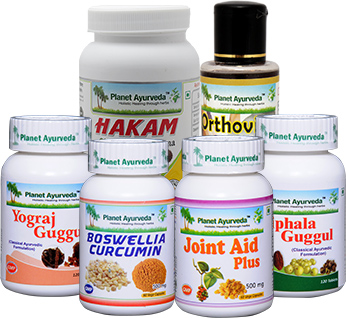
There are a variety of medicinal products prepared by Planet ayurveda. The products contain natural herbs beneficial for the health of the body. There are various preparations of natural herbs such as Joint Aid Plus, Yograj Guggul, Hakam Churna, Boswellia-Curcumin, Orthovita Oil, Triphala Guggul etc. which are prepared using authentic ways and provide great results in improving the condition of lumbar canal stenosis. All the herbal products manufactured here are free from chemicals, preservatives, starch, additives, colors and fillers. These products are hundred percent natural and are formulated by MD Ayurvedic doctors with deep knowledge of Ayurveda and many years of experience. The formulations are prepared strictly according to the procedures described in the samhitas (classical texts) and therefore are very effective in promoting the health of the patient and managing the diseased state effectively.

  1. Joint Aid Plus
  2. Boswellia+Curcumin
  3. Orthovita Oil
  4. Yograj Guggul
  5. Hakam Churna
  6. Triphala Guggul

lumbar canal stenosis care pack

PRODUCT DESCRIPTION

1. Joint Aid Plus

Joint Aid Plus capsules are prepared by Planet Ayurveda. It is created by combining various natural herbs such as Nirgundi (Vitex negundo), Shallaki (Boswellia serrata), Guggul (Commiphora mukul), Sonth (Zingiber officinale), Ashwagandha (Withania somnifera), etc. This combination will help in balancing the vitiated vata in the body. It helps in relieving pain in the bones, joints etc. Thus, it will improve the condition of lumbar canal stenosis.

Dose: Joint aid plus capsules can be given one to two Capsules two times a day, with plain water and after meals.

2. Boswellia+Curcumin

Boswellia + curcumin capsules are prepared by Planet Ayurveda by combining the following medicinal herbs i.e. Shallaki (Boswellia serrata) and Haridra (curcuma longa). It promotes the overall health of the body which helps in managing the pain impulses. These capsules help in managing the condition of lumbar canal stenosis.

Dose: The dose of Boswellia + curcumin capsules is 1 capsule two times a day with plain water and after meals.

3. Orthovita Oil

The orthovita oil helps in reducing inflammation as it contains Shul Gajendra Oil, Gandhapura oil, Turpentine Oil, Saindhavadi Tail, Prasarini oil, and Camphor. It also helps in reducing the pain. Orthovita oil helps in managing the pain in the condition of lumbar canal stenosis.

Application – Apply warm orthovita oil over the affected area and gently massage once or twice daily.

4. Yograj Guggul

Yograj guggul contains Commiphora mukul (Gum Guggul), Cyperus rotundus (mustak), Plumbago zeylanica (Chitraka), Emblica officinalis (amla), Terminalia bellirica (Bhibhitaki), Terminalia chebula (haritaki), Piper longum (Pippali), Carum copticum (Ajwain), Embelia ribes (Vidanga), Tribulus terrestris (gokshura), Cuminum cyminum (Jeerak), Elettaria cardamomum (Ela), Rock salt, Zingiber officinale (sonth),etc. This combination is very beneficial and helpful in reducing the inflammation and pain. It helps in the effective management of lumbar canal stenosis.

Dose – Yograj guggul can be given two tablets two times a day with warm water. It should be taken thirty minutes after meals.

5. Hakam Churna

Hakam churna contains herbal combination of the following herbs Chandershoor (Lepidium sativum), Kalonji (Nigella sativa), Fenugreek (Trigonella foenum graecum) and Ajwain (Trachyspermum ammi). It helps in eliminating the vata dosha from the body. Hakam churna is beneficial in improving digestion. This also helps in the pacification of vitiated vata dosha from the body.

Dose – Hakam churna can be given half teaspoon, two times a day with warm water, before meals.

6. Triphala Guggul

Triphala Guggul contains Haritaki (Terminalia chebula), Amalaki (Emblica officinalis), Vibhitaki (Terminalia bellerica) and Guggul (Commiphora mukul). It helps in rejuvenation of the body cells. It helps in management of stiffness and pain in the neck in the condition of lumbar canal stenosis.

Dose – Triphala Guggul can be given one tablet two times a day with warm water. It is taken after meals.

CONCLUSION

The lumbar canal stenosis can reduce the quality of life of the patient. This condition needs proper and timely management. The Ayurvedic formulations described above are very effective in managing the condition properly. The use of these above mentioned Ayurvedic herbs will help in improving the quality of life of the patient. For more details of our products check out our website www.planetayurveda.com and for queries you can send your queries to our email id herbalremedies123@yahoo.com .