Liver is the prime organ of detoxification and the main organ involved in regulating the chemical levels in the blood. The main job of the function is filtering the blood coming from the digestive tract and then passing the purified blood to other parts of the body. Due to regular intake of unwholesome articles like alcohol and use of other modern medications (such as steroids and antihypertensive drugs etc.) for a longer duration of time and other causes lead to the gradual alteration in the liver tissues which result in the loss of functions of liver and ultimately leading to liver disorders. In this article we’ll discuss the common clinical features and general causes/risk factors for the liver disorders along with the best herbs for preventing & treating the liver disorders.
SIGN AND SYMPTOMS
The clinical manifestation of the liver disorder depends upon the degree of damage to the liver or severity or chronicity of the disease. However, the common clinical picture of various liver disorders may appear as yellowish discoloration of eyes and skin (jaundice), abdominal pain and swelling specifically in right hypochondriac region and severe itching, chronic fatigue, abnormal appetite (mostly reduced or loss of appetite) with difficulty in digestion resulting in multiple and frequent episodes of nausea and vomiting, darkening of the color of urine and edema in legs and ankles.
CAUSES
There are numerous causes that lead to liver disease. The most common causes/ risk factors for developing liver disease include genetic predisposition, heavy alcohol intake, obesity, diabetes mellitus (type 2), viral infections, unprotected sex, blood transfusion, overuse or long term use of modern medicines having hepatotoxic side effects, etc.
AYURVEDIC VIEW
Various liver disorders are categorized under the general term yakrit roga in Ayurveda. Yakrit rogas ranges from kamala (jaundice), halimak (green texture in stool; a complication of kamla), kumbh kamla (ascites due to jaundice/liver cause), yakrit vidradhi (hydatid cyst), yakrit vridhi (hepatomegaly), yakridalodar (cirrhosis of liver), yakritarbud (tumors of liver) and other such diseases. The main vitiated doshas involved are tridosha with the predominance of pitta.
AYURVEDIC HERBS FOR LIVER DISORDERS
1. Bhumyamlaki
(Phyllanthus niruri) contains the phytochemical Phyllanthin in the leaves which have hepato-protective activity. It has been indicated in kamla (jaundice), yakrit-pleehavridhi (hepatomegaly-splenomegaly) and other blood disorders along with urinary tract related disorders and respiratory disorders. This herb is proven to have anti-inflammatory properties in various hepatitis conditions and has significant results in reducing the AST- ALT levels.
(Picrorhiza kurroa) It is rich in picrorhizin, along with other phytochemicals that include deepak appetizer, pachak digestive stimulant, and pitta virechak (aids in pacifying pitta). It functions mainly on the liver and intestines. Also, its bhedni guna is very beneficial in breaking down the accumulation of endotoxins and then removing those through purgation.
3. Kalmegh
(Echinacea- Andrographis paniculata) is another beneficial herb for liver problems such as fatty liver, alcoholic liver disease. This herb is used in liver disorders as it removes the accumulated toxins within the liver and contains phytochemicals such as alkaloids that promote the regeneration of the damaged liver cells.
4. Makoy
(Solanum nigrum) is a small weed-like herb with amazing healing properties. It also acts primarily on the liver by bringing down the raised level of alkaline phosphatase, due to underlying liver diseases such as alcoholic liver damage, fatty liver and all types of hepatitis and side by side fastening up the regeneration process of the liver cells.
5. Punarnava
(Boerhavia diffusa) is the best herbal diuretic herb. It aids in removing the excess fat and fluid from the body. Obesity as mentioned above is the main risk factor for developing liver disease and its diuretic action aids in getting relief from the ascetic or hepatomegaly conditions resulting from various liver disorders.
6. Kasni
(Cichorium intybus) has the unique ability to heal the liver cells even in the worst conditions of the liver. It is the blood purifier, thus helping in reducing the excess load on the liver, preventing the liver cells from further damage by free radicals and also providing time for the better and faster healing of the liver in various liver disorders.
7. Sharpunkha
(Tephrosia purpurea) is the most effective herb for enlarged liver and spleen. It helps in the regeneration of liver cells and also regenerates the capacity of the spleen to hold blood. Sarpunkha is a natural alkalizer that helps in reducing abdominal discomforts such as hyperacidity and flatulence due to liver problems.
8. Bhringraj
(Eclipta alba) has been a well known herb for hair related problems since ages. But latest research shows that this herb has a wonderful role in normalizing the liver functions and helps in regeneration of new liver cells. It is beneficial in liver damage due to excessive toxins, fatty liver and other such conditions.
9. Haritaki
(Terminilia chebula) is the best herb for detoxification of the body as it removes the toxic material by breaking up the blockages in the channels in the intestines, and other ducts, cleansing the body and reducing strain from the heart and other body organs. This will ultimately enhance the human body’s capability to recover from the ongoing disease and also make the action of herbal drugs more effective. It is used for therapeutic purgation, removes the toxins directly from the intestine reducing stress on the liver and promoting the faster recovery of the liver from various liver disorders.
Planet ayurveda is a globally emerging manufactures and supplier of herbal formulation that are made with the strict adherence to ancient ayurvedic texts.
Planet Ayurveda’s experts made the combination of herbal formulations for various liver disorders under the name of LIVER CARE PACKandThese packs contain a combination of 4 efficient formulations i.e. Yakrit Plihantak Churna, Echinacea Capsules, Phyllanthus Niruri, and Liver Detox Formula.
1. Yakrit Plihantak Churna
It is an amazing classical polyherbal blend beneficial for various liver and spleen related disorders. Its ingredients include katuki, bhumyamalaki, kalmegh, makoy, sarpunkha, kasni, bhringraj etc
Dosage-1 tsp twice daily with plain water after meals
2. Phyllanthus Niruri
these are the standardised extract of bhumyamalaki prepared in the house of Planet ayurveda. It has hepatoprotective properties due to which it detoxifies liver cells.
Dosage– 2 capsules twice daily with plain water after meals.
3. Echinacea capsules
Echinacea capsules are single herbal formulations prepared using standardized extract of Kalmegh (Andrographis paniculata). It is also a very good herb for managing Liver disorders.
Dosage– 2 capsules twice daily with plain water after meals.
4. Liver Detox Formula
it is best product made by Planet Ayurveda’s team for the detoxification of the liver and the whole body. It contains hepatoprotective herbs such as kalmegh, makoy, punarnava and purgative drugs such as haritaki and katuki along with other herbs.
Dosage– 2 capsules twice daily with plain water after meals.
Liver is one of the unique organs having the regeneration capabilities in the hepatocytes even after damage due to diseased condition, if adequate nourishment is provided to the liver along with these herbal supplements, one can prevent or treat various liver disorders.
Everyone in the world is busy making money through jobs or business and other things. But no one really cares about the body they have. It is really essential to understand that the body is the base of every emotion you have, every feeling you feel, every work you do and every thought you have. Not taking care of your body gives a chance to diseases, disorders and conditions to rise in your body and maximum of these diseases, disorders or conditions are due to fluctuating lifestyle and dietary habits. Lifestyle includes all the things we do like prolong sitting for hours, too much work on screen, no fixed time of eating along with dietary habits like eating too much fast food, binge eating, eating without thinking etc. give rise to many lifestyle disorders and one of such diseases is piles. Piles has become a really common problem especially in the youngsters and this article is all about piles, its ayurvedic aspect and its management using ancient herbs and formulations.
Introduction
Piles, one of the most common problems encountered in today’s world and the surprising thing is that people sometimes don’t even know that they have piles. In Ayurveda piles is known by the name Arsh and ancient texts also mentioned its types like vataj Arsh (having predominance of vata dosha), piitaj Arsh (having predominance of pitta dosha), kaphaj Arsha (having predominance of kapha dosha) and raktaj Arsh (bleeding piles). The modern concept of piles explains that piles are of three types that are internal, external and prolapsed. The article will cover both of the aspects along with the approach of management for piles. Though the protocol is a bit similar but still has differences at some point. Medically piles are called hemorrhoids. Hemorrhoids simply means a swollen vein or group of veins in the anus region, either externally or internally.
Causes of piles
The cause of piles is just one that is increased pressure in the lower rectum and this increased pressure is the responsible factor for formation of piles. So what are the reasons for this increased pressure? Keep on reading if you want to know the reasons!!
The reasons for increased pressure in lower rectum are following
The first and the most common is constipation. Constipation increases the pressure on the lower rectum which finally can result in both internal or external piles.
The second most common cause for increased lower rectum pressure is pregnancy. In pregnancy, as the uterus expands it puts pressure on the rectum placed just behind it resulting in piles. Again these piles can be internal or external.
The next reason is chronic diarrhea. Diarrhea can be the reason for piles in patients like ulcerative colitis and crohn’s disease.
Other causes include habis like straining while passing stool, lifting weights, prolonged sitting,having chillies in excess, increased intake of alcohol, having too much refined grains etc.
In Ayurveda there are certain specific causes for onset of piles or any type of Arsha. These includes
Intake of heavy, sweets, cold and abhishyandi aahar (food which is heavy and slimy) , vidahi aahar (causing burning in stomach), viruddh anna (improper food combinations).
Indigestion, eating less in quantity
Asaatmaya food (improper food)
Intake of Cow meat, fish, pig meat, buffalo meat, goat meat, sheep meat in heavy quantities regularly.
Excessive sneha paan (intake of ghee), curd, sesame and jaggery intake
Doing no exercise
Sleeping in day time
Indigestion
Prolonged constipation
These all causes can cause all types of arsha or piles. But these situations arise only when a person is not having a good lifestyle as well as dietary habits.
Prodromal symptoms
The prodromal symptoms refer to or donate the period between the appearance of initial symptoms. So for all type of arsha or piles, Ayurveda mentions following prodromal symptoms:
Indigestion (Vishtambh)
Flatulence (Aatop)
Weakness (dorbalaya)
Constipation (vibandha)
Emaciation (kasharya)
Excessive belching (Udgaar bahulya)
Pain in thighs (Sakthi sadan)
Sprue (Grahni dosha)
Anaemia (Pandu)
Abdominal disorder (Udar roga)
Polydipsia (Pippasa)
Small quantity of stool (alpa vitakta)
Symptoms of Arsha or piles According to Ayurveda and Modern
Pain and burning in anal region (daha and shoola in gudda)
Sometimes even bleeding per anus is also observed (rakta sarava)
Constipation (Mal badhta)
Diarrhoea (atisaar)
Flatulence (aatop and aadhmaan)
On the other hand Modern explains the symptoms of piles in two types that are external symptoms and internal symptoms. Obviously the internal symptoms are for internal piles and external are for external piles.
Symptoms of internal piles
Painless bleeding during bowel movements. The blood is bright red in colour.
A pile pushing through anal opening called as protruding or prolapsed pile.
Symptoms of external piles
Itching and irritation in your anal region
Discomfort and pain
Bleeding
Swelling around anus region
There is an additional type of pile called a thrombosed pile. The blood pools in an external hemorrhoid or external pile thus forms a clot which can result in severe pain, swelling, inflammation and a hard lump near your anus.
Diagnosis internal and external piles
The diagnosis of piles can be done using digital and visual examination.
1. Digital examination
Inserting a gloved lubricated finger into your rectum by your doctor for inspecting any unusual growth.
2. Visual examination
Proctoscopy is done by inserting a proctoscope inside your rectu as internal piles are really soft to feel. This examination visualizes the lower portion of rectum.
Criteria for treatable and untreatable piles according to Ayurveda
1. Sadhya arsha (treatable piles)
There is predominance of only one dosha that is either kapha, pitta and vata dosha
Below the dentate line
The pileous mass that is not older than one year.
2. Krich Sadhya (treatable with difficulty)
Having dominance of two doshas.
Present above dentate line.
Pilous mass older than one year.
3. Asadhya pile (non treatable piles)
The patient has piles with swelling over feet, face, mouth, umbilicus, anus and heart along with pain in ribs.
Patient suffering from vomiting, pain in body, fever, thirst and pus in anal region.
Piles present from birth
The pilous mass having predominance of all three doshas
Present above the dentate line.
Treatment (According to Ayurveda and Modern)
The Ayurvedic for piles is described by Two Aacharyas. Aacharya charak explains the treatment with internal administration and panchakarma procedures of medication and acharya Sushruta explains four different ways to treat piles.
Let’s discuss the treatment according to Aacharya charak first
Vaman karma (vomiting induced by administration of emetic drugs)
Virechan karma (Purgation induced by administration of laxative drugs)
Basti (Asthappan and anuvasana basti): Medicated enema using unctuous decoction and non unctuous decoction.
Picha basti (Enema prepared using milk and effective herbs)
2. San Shaman chikitsa (Internal medicine)
The Ayurvedic texts describe use of effective formulations which include
Rasa aushadiya also like arsh kuthar ras, ashtanga ras,
Some vatis like jatiphaladi vati, chandra prabha vati,
Some powdered formulations like vijay churna, dhaturadi churna etc.
Along with the administration of some decoction formulations like takrarishta, abhayarishta, kankarishta, draksha aasav and
Some ghrita formulations like chavya ghrita, pippalyadi ghrita etc.
On the other hand Acharya Sushruta explained four sidhanta for the chikitsa of arsh. The four sidhanta are as follows:
Bheshaj (that is internal medicine): In arsha having less aggravation of dosha and are with less complications
Kshar karma (In soft, bleeding or in Arsha having dominance of pitta dosha)
Agni karma (In hard and in arsha having predominance of vata and kapha dosha)
Shstra karma (In Arsha having soft root and presence of all three dosha)
Modern treatment for Arsha or piles
There are several types of hemorrhoid surgery available. Let’s get to know about all of them. The following are the procedures done to remove piles:
1. Rubber ligation
The procedure is done for the bleeding piles or prolapsed internal hemorrhoid. The procedure involves placing a rubber band on the base of a hemorrhoid. This will help in restricting the blood flow and eventually causing hemorrhoids to fall off.
2. Coagulation
Coagulation is helpful in treating internal bleeding hemorrhoids which are not protruded. Basically a trained doctor will use an electric current or infrared light to create scar tissue on the hemorrhoid, thus restricting the blood supply to the hemorrhoid and causing it to fall.
3. Sclerotherapy
In sclerotherapy this procedure involves a doctor injecting a chemical solution into internal hemorrhoids. The solution helps in relieving pain as it makes nerve endings numb and causes a scar tissue formation. Thus hemorrhoids fall.
4. Hemorrhoidectomy
This procedure aims to remove the hemorrhoid and the procedure is performed by the expert surgeon under local anesthesia or will receive a spinal block.
5. Hemorrhoid stapling
The procedure is especially for internal hemorrhoids and has no significance for external hemorrhoids. A special device is used to staple the hemorrhoids to normal position within the anal canal. This restricts the blood supply and causes reduction in size slowly.
If your doctor does not guide you for any of the above mentioned procedures then you are probably in a good condition. So generally some laxatives and ointments are prescribed. Now after knowing all about piles in both Ayurveda and Modern science let’s proceed towards some natural cures of piles as mentioned in Ayurvedic texts. These ways can be of great help for an immediate relief.
These are as following
1. Sudation or swedan
The sudation or swedan is really helpful especially in stiff and swollen pilous mass. Generally the swedan is done using potli swedan. In potli swedan a cloth packet in round shape and is filled with various herbs like yav (Hordeum vulgare), masha (Vigna mungo), kulathi (Macrotyloma uniflorum) and Pulaka (tucchadhnnya). The potli is generally applied after smearing it in oil prepared using chitraka (Plumbago zeylanica) and Bilva (Aegle marmelos).
2. Ava Ghana (Sitz bath)
Sitz bath after mixing alum in the water is a very effective hemostat and also relaxes the swollen piles, reduces stiffness and thus is really effective in reducing discomfort too. Before a sitz bath one can apply jatyadi tail.
3. Jatayadi tail pichu
This involves application as well as insertion of jataydi oil in or into the anal opening.
4. Pralepa (ointments)
The ointment is prepared using powder of haridra (Curcuma longa) mixed with latex of Snuhi (Euphorbia neriifolia). The paste is really helpful to reduce swelling over the pilous mass present.
Herbal formulations by Planet Ayurveda
Planet Ayurveda is a leading Ayurvedic firm which deals with the manufacturing of herbal formulations. These formulations are prepared using potent herbs which are really effective in managing many conditions related to immune system disturbances and its working. The formulations prepared by Planet Ayurveda do not contain any kind of adulterants, dyes, additives, fillers etc. These medications are really potent to manage various conditions related to all the anorectal conditions especially and are very fruitful hence giving positive noticeable results. The medication or formulations offered by Planet Ayurveda for the management of piles as follows
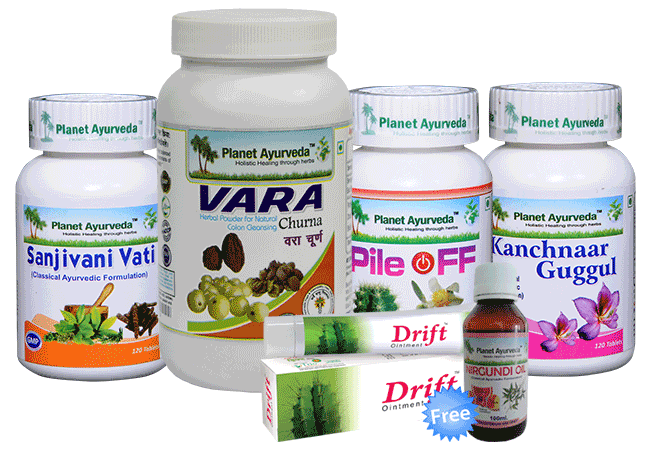
Piles Care Pack
Sanjivani vati
Vara churna
Kanchnaar Guggul
Pile off capsules
Nirgundi oil
Drift ointment
PRODUCTS DESCRIPTION
1. Sanjivani Vati
Sanjivani vati is popularly known to infuse life. It is best for ama digestion and also helps in burning the accumulated toxins. This is also a classical formulation and contains many herbs like sonth (Zingiber officinale), vidanga (Piper retrofractum), giloy (Tinospora cordifolia), triphala etc. These all combinedly strengthens the immune system and hampers the recurrence of any disease. These herbs when ingested and passed through the intestine creates an environment that is suitable for healthy digestion. It all over works by enhancing the digestion power and provides a very good and positive effect on digestion processes as well as on the digestive system.
Dose: Two tablets twice a day after meals along with lukewarm water.
2. Vara Churna
Vara churna is based on a classical preparation called as triphala churna. It consists of amalaki (Emblica officinalis), bibhitaki (Terminalia berberica) and haritaki (Terminalia chebula). This combination is the best combination which acts as a stool softener and laxative also. It also has an antioxidant effect. It works by the bhedan of stool in the colon and reduces chances for constipation which is the main reason for onset of piles. Vara churna is the best stool laxative and has a very great impact on digestion as well as on piles.
Dose: Half teaspoon twice a day after meal with lukewarm water.
3. Kanchnaar Guggul
Kanchnaar guggul is a classical formulation that has constituents like bark of kachnar (Bauhinia variegata), amalaki (Emblica officinalis), haritaki (Terminalia Chebula), bibhitaki (Terminalia bellerica), black pepper (piper nigrum) and others. These all ingredients help in reducing the size of swollen piles. It is also very beneficial in reducing the size of piles or prevents its further growth. The formulation is also very effective in reducing the chances of recurrence as well as chances of any complications further.
Dose: Two tablets twice daily after meals with lukewarm water.
4. Pile off capsules
Pile off is a poly herbal formulation and is specifically used in management of piles. This herbal formulation is prepared from the standardized extracts of Haridra (Curcuma longa), Pippali (Piper longum), Maricha (Piper nigrum), Shunthi (Zingiber officinale), Sajjikshar (Soda bi carb powder), etc. It relieves pain, stinging feeling and inflammation over the pile mass. The capsules also help in smooth evacuation of stools. These capsules normally relax the nerves and hence reduce tenderness or stiffness present over pile mass.
Dose: One capsule twice a day with lukewarm water after meals
5. Nirgundi oil
The nirgundi oil is a medicated oil preparation useful in piles and also in some kinds of wounds. The oil is formulated with herbs like Nirgundi (vitex negundo), Manjishtha (Rubia cordifolia), Haridra (Curcuma longa), Kalahari (Gloriosa superba), etc. All of these herbs have anti-inflammatory, analgesic and antiseptic properties. Thus they are helpful in pain, swelling and any kind of infection. The oil protects the piles from getting infected.
How to apply: Just apply this oil over the pile mass two times a day with the help of cotton.
6. Drift ointment
The ointment is used for the management of all kinds of anorectal disorders. It relieves itching and pain over pile mass. It also reduces bleeding and swelling in the affected area. This ointment contains herbs like nirgundi beej (seeds of Vitex negundo), Lajjavanti (Mimosa pudica), Bhringraj (Eclipta alba), etc. These all ingredients are helpful in shrinking the pile mass and also help in reducing the pain and other associated symptoms.
How to apply: Directly apply over the pile mass two times a day
Conclusion
Piles is basically a lifestyle disorder and sometimes such conditions are at peace if you try to bring some positive change in your diet and lifestyle. No doubt, we all have a busy schedule but as I mentioned before, taking care of our bodies is also our duty and we should do it at any cost. It does not require anything more than just a try and obviously an honest try. Try to control the craving and try to push for not being lazy. The above mentioned products are totally natural and do not cause any kind of side effects. In case of any query kindly visit www.planetayurveda.com