Natural Cure For Achalasia Cardia

ABSTRACT
In this article our main topic of discussion will be a very rare kind of disorder known as achalasia cardia. There are various kinds of health related ailments present in our surrounding some of them are very common about which everyone is well aware of, but there are some kind of ailments that occur very rarely, but carry great weightage in impairing our lifestyle. So let’s start putting some rays of limelight on how ayurveda deals with such ailments.

INTRODUCTION
Achalasia cardia is defined as difficulty in passing food and liquid into the stomach. It occurs due to the result of damage to the nerves present in the esophagus. It is characterized by the presence of impaired relaxation of the lower esophageal sphincter (LES) during the deglutition (swallowing) process leading to regurgitation of food back into the esophagus. The nerves of the esophagus become damaged and paralyzed; eventually they lose the ability to squeeze food down into the stomach. So it starts passing backward towards the mouth leading to the regurgitation of the food. As per ayurveda these kinds of disorders occur due to the presence of genetic deformity leading to generation of such ailments.
ETIOLOGICAL FACTORS
These are the main causes (nidan as per ayurveda) that results in formation of an ailment. Cause of achalasia cardia is not completely known, but various theories have been postulated, such as
- Presence of infection.
- Genetic involvement- Heredity is considered to play a major role in this.
- Viral infections
- Autoimmunity- Presence of an abnormality in the immune system, provoking it to cause damage to the own cells or particularly damage to esophageal muscles and nerves.
According to Ayurveda
- There is an involvement of imbalance between the tridosha (three principle energies of our body- vata, pitta and kapha). Other important causes of such disorders are:
- Presence of deformity in mother’s ovum and father’s sperm.
- Intake of unwholesome diet by a pregnant lady.
- Deformity in the beej bhaag (chromosomes) and beej bhag avyava (genes)
CLINICAL FEATURES
Most common characteristic feature seen in the patient of achalasia cardia is the regurgitation of the food into the throat.
Others are
- Presence of pain in the chest region.
- Weight loss.
- Weakness
- Fatigue and malaise
- Inability to swallow (dysphasia)
- Heartburn
- Belching
- Increased coughing at night time.
- Vomiting.
- Anorexia (loss of appetite)
- Muscle loss.
DIAGNOSIS
- Through physical examination of the patient by using:
- Inspection
- Palpation
- Auscultation
- Percussion
- Radiation examination:
- Barium swallow test
- In this barium in liquid form is given orally to the patient, and then the movement of this barium solution is seen through radiological investigation.
- Chest x ray: Shadow of the mass is seen clearly behind the sternum.
- Upper esophagogastroduodenoscopy.
- High resolution manometry (HRM) – to check rhythmic muscle contraction of esophagus when we swallow food.
According to Ayurveda
The two most preferred diagnostic procedures used by a physician are as follow
Trividh Pariksha (Group of 3 diagnostic procedures)
- Darshan- Diagnosis is made by visual examination of the symptoms.
- Sparshan- Physician uses tactile examination to evaluate whether skin is cold/hot
- Prashan– Physicians ask direct questions from the patient, to evaluate the root cause of the disease i.e. history taking.
Asthavidh Pariksha (Set of 8 examination procedure)
- Nadi pariksha– By palpating the pulse rate of the patient.
- Mutra pariksha– By examining the urine of the patient.
- Mal pariksha– By stool examination.
- Jivha pariksha– By examining the tongue whether coated or not.
- Shabad pariksha– By listening to the natural sounds within the body like intestinal sound (peristalsis) sounds of moving body fluids.
- Sparsh pariksha– By observing the patient skin texture whether it is cool, wet or dry.
- Drik pariksha– When a physician inspects patient symptoms through his/her eyes.
- Akriti pariksha– When a physician evaluates the general appearance of a patient whether he/she looks dull, lethargic or fatigued etc.
MANAGEMENT
Our main focus will be on stretching the lower esophageal sphincter, so that food will move easily down from the esophagus to the stomach.
Medications
- Muscle Relaxant- to relax the esophageal muscles.
- Antacids- for associated symptoms such as heartburn and acidity.
Surgery
- Heller myotomy- in this muscle at the lower end of the esophageal sphincter is removed surgically to allow food to pass more easily into the stomach.
- Per oral endoscopic myotomy (POEM) – an endoscope inserted through mouth into the esophagus to create an incision in the inside lining of your esophagus.
As Per Ayurveda
We can manage such ailment by using below listed treatment modalities
A. Sanshodhan Chikitsa (detoxification and purification therapy)
- In sanshodhan chikitsa we will purify the inner channels of our body (srotas) by using different procedures. Acharya charaka included five procedures in it, they are as follows- vaman (emesis), virechana (purgation), anuvasana basti (enema with medicated oil), niruha basti (enema with medicated decoction) and nasya karma (adding drops of medicated oil/ churna in the nostrils).
- Before using sanshodhan chikitsa we need to use purva karma (foremost procedures) – they are the set of procedures that need to be done before main panchakarma procedures. They are very important as they help in preparing the body for the main purification procedures. It includes: deepan karma, pachana karma, snehana karma and swedana karma.
- Deepan karma: In this we use deepaniya dravya to increase the digestive fire of the body.
- Pachana karma: In this we use pachana dravya to digest the food substances.
- Snehana karma (oleation therapy) – Smoothing the body dosha’s by using herbal ghrit/oil.
- Svedan karma (sudation therapy) – Semi-hot medicated kwath or other herbal solution is sprayed on the patient’s body by a specially made swedan yantra (instrument).
- Vaman (emesis) – In this procedure we do elimination of toxins by using emetic herbs to take out vitiated kapha dosha from the body.
- Virechana (purgation) – In this we use purgative herbs to take out vitiated pitta dosha from the anal route by purgation technique.
B. San Shaman Chikitsa (alleviating treatment)
- In this treatment modality we use the herbal medicines by oral route to balance vitiated doshas within the body itself.
- In this we can also use herbal formulation of planet ayurveda, as their products are made up of pure and standardized extract of herb and their products are also 100% organic and free from harmful chemicals and preservatives.
HERBAL REMEDIES OF PLANET AYURVEDA
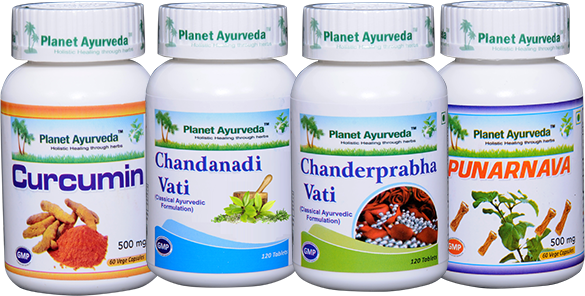
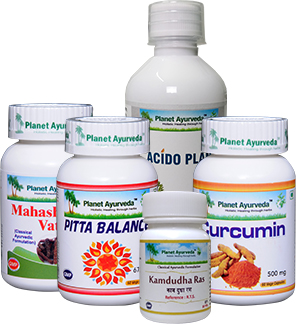
Planet ayurveda is a leading herbal manufacturing unit serving people worldwide with their authentic approach of healing by using principles of ayurveda. They have various herbal formulations that will work very efficaciously in conditions like achalasia cardia, it includes
- Mahashankh Vati
- Pitta Balance
- Curcumin Capsules
- Acido Plan Syrup
- Kamdudha Ras

Product Description
1. Mahashankh Vati
This herbal capsule contains herbs such as shunthi (Zingiber officinalis), pippali (Piper longum), shuddha vatsanabha (Aconitum ferox) etc. It works on the tridosha level by stimulating the digestive system in a healthy way. Herbs present in this possess good digestive property so it will help in maintaining healthy and sound digestion that will prevent the regurgitation of food back towards the throat.
Dosage: 1-2 tablets two times a day with plain water.
2. Pitta Balance
This potent formulation is an efficacious blend of praval pishti (coral calcium), akik pishti (Agate calcium), jawar mohra pishti (an ayurvedic calcium compound), giloy satva (stem extract of Tinospora cordifolia) etc. Minerals and herbs present in it have sheet virya (cold potency) thus works very well in reducing elevated pitta dosha within the body and elevated pitta dosha is considered as the main culprit of achalasia cardia.
Dosage: 1-2 capsules two times a day with plain water after meals.
3. Curcumin Capsules
This herbal capsule contains pure extract of haridra (Curcuma longa). Haridra is a natural herb that aids in wound healing excellently and also maintains immune system functions, increases the disease combating power of our body so assists in achalasia cardia profoundly.
Dosage: 1-2 capsules two times a day with plain water.
4. Acido Plan Syrup
This herbal syrup contain medicinal herbs such as patola (Trichosanthes dioica), ghrit kumari (Aloe barbadensis), saunf (Foeniculum vulgare), kokum (Garcinia indica), pitta papada (Fumaria indica), shatavari (Asparagus racemosus) etc. This formulation is very effective in digestion related ailments and mainly pacifies pitta dosha. It is a good appetizer also.
Dosage: 2 teaspoons twice a day.
5. Kamdudha Ras
This herbomineral formulation is a very efficacious blend of amrita satva (extract of giloy), abhrak bhasma (silica bhasma), praval pishti, shankh bhasma etc. This combination is made to balance the vitiated pitta dosha, as it is the main culprit behind achalasia cardia so this formulation works really well in Kamdudha Ras.
Dosage: 1-2 tablets twice daily with plain water after meal.
CONCLUSION
Now we can conclude that ayurvedic herbs are very effective in managing as well as preventing diseases like achalasia cardia. As ayurveda follow the treatment protocol of ‘nidan parivar jan chikitsa’ (avoiding the root cause of disease). In chronic venous insufficiency, the most common cause is prolonged standing. So with ayurveda, we can sustainably save ourselves from such ailments by following the ideal dietary and lifestyle regime of “dinacharya and ritucharya”. So do consider to opt for ayurvedic treatment by visiting planet ayurveda. They are serving mankind with their authentic approach of healing. In case of any query kindly visit www.PlanetAyurveda.com