October 20, 2026
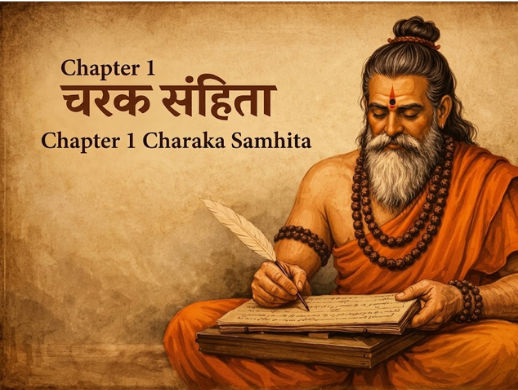
Chapter 1 Charak Samhita
ABSTRACT
Ayurveda is known as Ayurvedic Medicine, a traditional Indian Medicine. It is an example of a well-organised way to maintain health both preventive and in a curative way. It originated in India, 3000 years ago and is commonly known as the “Mother of all healing”. It stems from Vedic Culture, which was taught many thousands of years ago in a very traditional way. Ayurveda tells about the three basic energies Vata, Pitta and Kapha which are present in all Individuals. The Basic Principles of ayurveda were seen in the premature stage during the Vedic stage like Charak, Sushruta and Vagbhata who created the Ayurvedic classics, which established the Principles of Ayurveda. The Charak Samhita, Sushruth Samhita and Ashtanga Sangraha are the forms of Brihat Trayi. Their texts were written in the form of Sutras and other rhyming literature which are termed as Tantra. Charak Samhita is originally written by Agnivesh which is redacted by Charak and Completed by Dridhbala. It mainly concentrated on the branch of ayurveda which is known as Kayachikitsa, including the diagnosis of disease along with the Treatment aspects. Sushrut Samhita mentions Surgical procedures, Kashiraj divodasa taught various surgical skills to Sushrut. In panchkarma, leech therapy is also mentioned by the application of leech. He also described different types of fractures, burns and anorectal surgeries. Ashtanga Sangraha and Asthanga Hridayam named after Vagbhata treat the physiology of the body. The first chapter of Charak Samhita Deergha Jeevithaya Adhyaya, tells us about Longevity. Here we will discuss how various factors play an important role in our lives.
INTRODUCTION
Charak Samhita is a Sanskrit text of Ayurveda, which is based on the Agnivesha Samhita, 8th Century. In Sanskrit, Charak is termed for Wanderer who brought their Medical Expertise, Magico-Religious Rites from village to village. The text has eight Sthana which contains 120 chapters. The eight books are-
- Sutra Sthana (general Principles)- It has 30 chapters, which define Philosophy, definitions and the main goal is to maintain a healthy life.
- Nidana Sthana (pathology)- There are 8 chapters which describe the cause of the disease.
- Vimana Sthana– There are 8 chapters which contain specific determination. It contains the Physician, Pathology and Nourishment.
- Sharira Sthana- It describes the anatomy of the body and includes 8 chapters which describe embryology.
- Indriya Sthana– There are 12 chapters which are mostly based on the sensory response of the patients.
- Chikitsa Sthana– It has 30 chapters which deal with medicines and Treatment.
- Kalpa Sthana- 12 Chapters which describe the preparation, dosage of medications and dealing with Poisons.
- Siddhi Sthana– 12 chapters for curing symptoms and Signs for healthier and hygienic living
ORIGIN OF AYURVEDA
Lord Brahma recollected their knowledge of Ayurveda which was passed to Draksha Prajapati, then he shared his sacred knowledge with the Ashwini Kumar (twins who were considered Divine souls). Then Lord Indra learnt about Ayurveda. Then Saint Bharadwaj who was very desirous to know about Ayurveda, so he approached Indra and learnt about Ayurveda. Then Saint Bhardwaj passed his knowledge to Atreya Punarvasu, who taught Ayurveda to six Disciples- Agnivesha, Bhela, Jatukarna, Parashara, Harita and Ksharapani.
TRISUTRA
CHARAK SAMHITA 1/24
Indra found the immortal and sacred science of life which consists of Three Principles-
- Hetu (causative factors of disease)
- Linga (symptomatology)
- Aushadha Jnana (it is knowledge of Treatment and various medications).
These Hetu, Linga and Aushadha known as Trisutra are the three formulas for treating the disease.
SHAT PADARTHA
- Samanya (common)
- Vishesha (speciality)
- Guna (qualities)
- Dravya (substance)
- Karma (action)
- Samavaya (inseparable
DEFINITION OF AYURVEDA
- Charak Samhita 1/41 – Ayurveda is the science of life which defines-
- Hita Ayu– advantageous life
- Ahita Ayu– Disadvantageous life
- Sukhayu– Happy state of mind and health
- Ahitayu– Unhappy state of mind and health
DEFINITION OF AYU (LIFE)
The term Ayu stands for a combination of-
- Shareera- Body
- Indriya- Sense organs
- Satva- mind
- Atma- soul
This means that when the body is intact with sense organs, Mind and soul then it is known as Ayu (life).
Synonyms of Ayu (life)
- Dhari- Which prevents the body from any decay
- Jeevita- To Keep Alive
- Nityaga- This keeps the soul, mind and senses intact in the body without any discontinuation.
TRINDANDA
- Satva (mind)
- Atma (soul)
- Shareera (body) are the three tripods of life and the world is sustained with the combination and they constitute everything.
DRAVYAS-GUNA-KARMA AND SAMVAYA (BASIC MATTER)
Five basic elements
- Prithvi (earth)
- Ap (water)
- Tejas (fire)
- Vayu (air)
- Akasha (ether)
Together with Atma (soul)
- Mana (mind)
- Kala(Time)
- Disha (space) these are the basic nine elements
The substances are of two categories
- Saindriya- It states that sense organs and soul are the living substances
- Nirindryia Dravya- It does not have Sense organs and a soul as a living substance
GUNAS- QUALITIES
There are 5 Sartha Gunas +20 guruvadi Gunas + Buddhi + 6 Prayatnadi Gunas + 8 Paradi Gunas.
5 Objects Of Sense Organs
- Shabda (the sound which is perceived by the ears)
- Sparsha (touch which is perceived by skin)
- Roopa (a shape which is seen by the eyes)
- Rasa (taste which is perceived by the tongue)
- Gandha (Smell via Nose)
20 GURU ADI GUNAS
- Guru (heavy) X Laghu (light)
- Manda (slow) X Tiksna (quick)
- Hima (cold) X Ushna (hot)
- Slakshna (smooth) X Khara (rough)
- Sandra (solid) X Drava (Liquid)
- Mrdu (soft) X Kathina (hard)
- Sthira (stable) X Cala (moving)
- Suksma (stable) X Sthula (big)
- Vishada (Non-slimy) X Picchila (slimy)
ATMA (6 QUALITIES)
- Desire (Iccha)
- Hatred (Dvesha)
- Comfort (Sukha)
- Dukha (Grief)
- Buddhi (Intellect)
- Effort (Prayatna)
PARADI GUNAS
- Para (great)
- Apara (not great)
- Yukti (planning)
- Samkhya (number)
- Samyoga (combination)
- Vibhaga (division)
- Pruthaktva (individuality)
- Parimana (quantity)
- Samskara (processing)
- Abhyasa (habituation)
KARMA
It is defined as an act which is done with full effort known as Karma.
SAMAVAYA
It is the inseparable relationship which is seen between panchamahabhutas (Prithvi and Gandha), Tejas and Rupa and many more.
DRAVYA (MATTER)
Qualities (Gunas which do not have their action) and Action (Karma) are in inseparable relation which is known as matter (Dravya).
CAUSE OF DISEASE
The cause of disease which is related both to mind and body are as follows-
- Atiyoga- Excessive utilisation
- Heena Yoga- Less Utilisation
- Mithya Yoga- Wrong Utilisation
TRIVID HETU
- Kala- Time (prolonged summer, short summer or sometime heat is seen in other seasons)
- Artha- Excessive smelling, objects of smell and touch
- Buddhi- Is Excessive Thinking, Wrong Thinking and various actions.
SITES OF DISEASE
Body and Mind are the two seats for disease and Happiness.
DEFINITION OF ATMA (SOUL)
Nirvikara (the soul which is devoid of all deformities), is the main cause of consciousness and maintains the specific qualities of basic elements.
PHYSICAL AND MENTAL DOSHAS, TREATMENT
Physical factors which are affecting the body are Vata, Pitta and Kapha doshas.
Mental Doshas are Rajas and Tamas.
QUALITIES OF VATA DOSHAS
- Rooksha (rough)
- Sheeta (cold)
- Laghu (light)
- Chala (mobile)
QUALITIES OF PITTA DOSHAS
- Sneha (unctuous)
- Ushna (hot)
- Teekshna (sharp)
- Katu (pungent)
QUALITIES OF KAPHA DOSHAS
- Guru (heavy)
- Sheeta (cool)
- Picchila (slimy)
- Madhura (sweet)
TREATMENT
The Physical Doshas are balanced by-
- Daiva Vyapashraya Chikitsa- It is performed through religious rites
- Yukti Vyapashraya Chikitsa– Performed by a physician with proper planning.
The Psychological Doshas are balanced by- Rajas and Tamas are mainly balanced with meditation and scriptural Knowledge. As it wins the weakness of the mind and is so known as Satva Avajaya Chikitsa.
THREE TYPES OF MEDICINES
- Doshaprashamana– It balances the increased doshas
- Dhatu Pradushan– which imbalance the normal doshas to the abnormal stage
- Swasthavritta– which maintains health in the normal state.
TYPES OF SUBSTANCES
Jangama
(origin of animal source) such as honey, dairy products, bile, Gorochana and many other products originate from animal sources and are used in medicines.
Audbhida
Are of vegetable origin, such as latex, fruits, flowers and rhizomes are the class of drugs which are of vegetable origin.
- 16 types of roots– some are as follows Trivit, Jyotishmati, Bimbi, Dravanti, Ajagandha and more.
- 19 useful fruits– such as Vidanga, Ikshvaku, Jimuta, Abhaya and Kutaja.
- 5 types of salts– Sauvarchala, Saindhava, Vida, Audbhida and Samudra Lavan. These are good appetisers and are useful in purgation, elimination of doshas and correcting the process of indigestion.
- 8 varieties of urine– Urine of Sheep, Cow, Buffalo, Elephant, Camel, horse and Ass. Useful in the treatment of Skin diseases, Piles, constipation and many more. It is the best remedy for Pandurogas (anaemia) which when taken internally brings down the pitta doshas and alleviates Kapha and Vata doshas.
- 8 types of milk– Sheep, She-goat, Cow, She-buffalo, She- Camel, Mare and Woman. Useful in the female genital tract and in male reproductive fluid and useful in Vata and Pitta Imbalances disorders.
- 4 Varieties of fats- Ghee, Oil, Muscle fat and Marrow.
Parthiva
Metals which include minerals and are obtained from the ground such as Gold, Lohas, Calcite and Collyrium
THREE SPECIAL HERBS
- Snuhi (Euphorbia neriifolia)- Latex is usefulfor purgation
- Arka (Calotropis procera)– for both emesis and purgation
- Ashmantaka (Ficus rumphii) is useful in emesis
THREE TREES WITH USEFUL BARKS
- Putika (Caesalpinia crista) are useful for the process of purgation.
- Krishnagandha (Moringa oleifera)- are useful in Parisarpa (erysipelas), Different Shotha, Piles and ringworms.
- Tilvaka (Symplocos racemosa) Are useful in the process of purgation. Goat-Herds, Cow Herds and other forest dwellers know the name and form of the plant by their name. He is the real owner of them after knowing the use and having knowledge of their administration.
WISDOM OF RIGHT USAGE OF MEDICINE
Poison, Weapon and Fire if one does not know the proper dose usually kills the person and even the acute poison can become an excellent drug if it is administered properly. The medicine which is taken properly brings the disease to free condition and relieves the patient of various disorders. Success shows the proper measures which indicate that the physician has all the qualities.
SUMMING UP VERSUS
In ayurveda, the cause and initiation approve the composition, Decision and objects of Ayurveda, Etiological factors, Dosages and drugs in brief. Then we discussed the three categories of drugs, rooty and fruity-drugs, fats, salts and urine. There are six trees where the latex and barks are used, their action and proper administration, along with merits and demerits, qualified physicians in whom all the qualities are found! Has been described in the First Chapter.

Dr. Vikram Chauhan
https://www.planetayurveda.comDr. Vikram Chauhan (MD - Ayurveda) is a Globally Renowned Ayurveda Physician with Expertise of more than 25 Years. He is the CEO & Founder of http://www.PlanetAyurveda.com, a leading Ayurveda Brand, Manufacturing, and Export Company with a Chain of Clinics and Branches in the US, Europe, Africa, Southeast Asia, India, and other parts of the World. He is also an Ayurveda Author who has written Books on Ayurveda, translated into Many European Languages. One of his Books is "Ayurveda – God’s Manual for Healing". He is on a Mission to Spread Ayurveda All Over the Planet through all the Possible Mediums. With his Vast Experience in Herbs and their Applied Uses, he is successfully treating Numerous Patients suffering from Various Ailments with the help of the Purest Herbal Supplements, Diet, and Lifestyle, according to the Principles of Ayurveda. For More Details, visit - www.planetayurveda.com, www.alwaysayurveda.com
View more posts from this author