September 10, 2026
Upadacitinib: The JAK1 Switch Turning Down Inflammation In Rheumatoid Arthritis
Upadacitinib: The JAK1 Switch Turning Down Inflammation In Rheumatoid Arthritis—RA Care Pack As An Ayurvedic Alternative
Abstract
Rheumatoid arthritis (RA) is a chronic systemic autoimmune disease characterised by persistent synovial inflammation, pain, swelling, stiffness, progressive joint damage, and functional impairment. Although conventional and biologic disease-modifying antirheumatic drugs (DMARDs) have transformed RA management, some patients continue to experience inadequate disease control or intolerance to existing therapies. Upadacitinib is an orally administered, selective Janus kinase 1 (JAK1) inhibitor that targets intracellular signalling pathways involved in the production and activity of multiple inflammatory cytokines. By reducing JAK1-dependent signalling, it can suppress inflammatory activity and improve clinical manifestations of RA. Clinical trials have demonstrated improvements in disease activity, physical function, pain, morning stiffness, and remission rates, including in patients with inadequate responses to conventional synthetic or biologic DMARDs. Long-term studies have continued to demonstrate sustained efficacy, although careful monitoring for infections, herpes zoster, laboratory abnormalities, thrombosis, malignancy, and cardiovascular events remains essential. This article reviews the mechanism, therapeutic role, clinical evidence, safety considerations, and potential Ayurvedic interpretation of upadacitinib in rheumatoid arthritis.

Introduction
Rheumatoid arthritis is an immune-mediated inflammatory disorder in which dysregulated immune responses primarily affect the synovial joints. Persistent inflammation can cause synovial hypertrophy, cartilage destruction, bone erosion, deformity, and loss of physical function. The disease may also involve organs beyond the musculoskeletal system, making RA a systemic condition rather than simply a disorder of the joints. Modern treatment aims to achieve remission or sustained low disease activity through early and appropriately targeted DMARD therapy. Methotrexate remains a major component of initial treatment, while biologic DMARDs and targeted synthetic DMARDs are used when disease activity remains inadequately controlled. Upadacitinib has emerged as an important targeted synthetic DMARD. Unlike biologic medicines that generally act outside the cell by binding specific inflammatory mediators or their receptors, upadacitinib works inside immune cells by inhibiting JAK1-mediated signalling. This intracellular mechanism allows it to influence several cytokine pathways simultaneously.
Understanding the JAK-STAT Pathway
The Janus kinase-signal transducer and activator of transcription (JAK-STAT) pathway is an important communication system used by numerous cytokine receptors. When a cytokine binds to its receptor, associated JAK proteins become activated and phosphorylate STAT proteins. STATs then enter the nucleus and regulate gene expression involved in immune activation, inflammation, cell survival, and differentiation. JAK1 participates in signalling from several cytokines relevant to inflammatory diseases. Excessive or persistent cytokine signalling contributes to the inflammatory environment characteristic of RA. Therefore, interfering with this pathway provides a mechanism for reducing downstream inflammatory activity. Upadacitinib is designed to preferentially inhibit JAK1. The term “JAK1 switch” in the title is therefore a useful metaphor: rather than literally switching inflammation off, the drug reduces an important intracellular signalling route that helps maintain inflammatory responses.
How Upadacitinib Works in Rheumatoid Arthritis
Upadacitinib is a selective JAK1 inhibitor administered orally. By inhibiting JAK1, it decreases signalling through cytokine pathways dependent on JAK1 activity. This can reduce the expression and activity of inflammatory mediators involved in synovitis and systemic inflammation. The therapeutic consequence is not limited to one inflammatory molecule. Instead, modification of intracellular signalling can influence several cytokine-driven processes at once. This helps explain why clinical improvements may be observed across multiple domains of RA, including tender and swollen joints, pain, morning stiffness, physical function, and overall disease activity. Importantly, JAK signalling also contributes to normal immune defence and hematopoietic processes. Consequently, therapeutic inhibition can produce adverse effects as well as anti-inflammatory benefits. This dual nature makes appropriate patient selection and monitoring particularly important.
Therapeutic Role in Rheumatoid Arthritis
Upadacitinib may be used in adults with moderately to severely active RA when conventional treatment has not provided sufficient control or has not been tolerated, according to applicable regulatory indications. Treatment decisions should be individualised according to previous DMARD exposure, disease severity, comorbidities, infection risk, cardiovascular risk, and patient preferences. Clinical guidelines emphasise a treat-to-target strategy in RA, in which therapy is adjusted according to disease activity rather than simply continued indefinitely without reassessment. European Alliance of Associations for Rheumatology (EULAR) recommendations recognise JAK inhibitors, including upadacitinib, as targeted synthetic DMARDs but emphasise careful assessment of cardiovascular, malignancy, and thromboembolic risk when considering their use.
Safety Profile, Tolerability, and Monitoring
As a potent immunomodulatory agent, the therapeutic benefits of Upadacitinib must be balanced against its potential risk profile. Selective JAK1 inhibition alters immune surveillance mechanisms, requiring structured baseline screening and ongoing clinical monitoring.
Infectious Risks
The primary adverse events associated with Upadacitinib stem from immune suppression. Upper respiratory tract infections, urinary tract infections, and bronchitis are among the most frequently observed. Notably, JAK inhibitors as a class carry an increased risk for Herpes Zoster reactivation (shingles), likely due to the suppression of type I and type II interferon signalling essential for antiviral defence. Prior vaccination against Herpes Zoster is highly recommended before initiating treatment.
Thrombotic Risk
Clinical surveillance of the JAK inhibitor class has highlighted a potential increase in the incidence of Venous Thromboembolism (VTE), including deep vein thrombosis and pulmonary embolism. Risk factors such as advanced age, cardiovascular history, smoking, and baseline hypercoagulability require careful screening prior to prescribing Upadacitinib.
Laboratory Monitoring
Upadacitinib administration can cause transient or sustained alterations in biochemical and haematological parameters. Regular laboratory testing is recommended to monitor:
-
- Haematology: Neutropenia, lymphopenia, and mild decreases in haemoglobin levels.
- Lipid Profiles: Dose-dependent increases in total cholesterol, high-density lipoprotein (HDL), and low-density lipoprotein (LDL) cholesterol, typically managed with standard lipid-lowering therapy without compromising cardiovascular risk benefit.
- Hepatic Transaminases: Transient elevations in alanine aminotransferase (ALT) and aspartate aminotransferase (ALT), particularly when co-administered with hepatotoxic drugs like Methotrexate.
- Creatine Kinase: Mild elevations in serum creatine kinase without accompanying clinical myopathy.
Ayurveda Insight
While modern biomedicine targets molecular entities like JAK1 enzymes and cytokines, traditional systems of medicine explain chronic autoimmune inflammation through holistic physiological models. In Ayurveda, Rheumatoid Arthritis finds its closest clinical parallel in the disease entity known as Amavata.
The Concept of Amavata and Pathogenesis (Samprapti)
In Ayurvedic physiology, health is maintained by a state of equilibrium among the three doshas (Vata, Pitta, and Kapha), alongside a functional digestive and metabolic fire (Agni). Amavata develops through a dual pathological process:
Agni Mandya (Impaired Metabolic Fire)
Poor digestive capability leads to the incomplete digestion of food in the gastrointestinal tract, generating an endotoxic, sticky, systemic byproduct called Ama.
Vata Prakopa (Aggravation of Vata)
Factors such as a sedentary lifestyle, incompatible diet, physical overexertion, or emotional stress severely aggravate Vata dosha—the primary energy governing biological movement, circulation, and signal transmission.
The aggravated Vata acts as a transport vehicle, carrying the toxic, circulating Ama (toxins) throughout the body’s channels (Srotas) and lodging it within the synovial joints (Sleshma Sthana). Once Ama combines with Kapha and Pitta in the joints, it generates intense local inflammation, heat, swelling, severe stiffness, and structural deformity—a picture identical to the clinical presentation of Rheumatoid Arthritis.
Herbal Remedies as an Alternative to Upadacitinib by Planet Ayurveda
Planet Ayurveda is a wellness brand dedicated to promoting health through the traditional principles of Ayurveda and natural herbs. It offers a wide range of Ayurvedic formulations made with carefully selected herbs and natural ingredients. The brand focuses on supporting various aspects of health, including digestion, immunity, liver, joints, heart, and women’s wellness. Planet Ayurveda combines classical Ayurvedic knowledge with modern quality and manufacturing practices. Its products are designed to provide convenient herbal support for modern lifestyles. The brand promotes a holistic approach that considers nutrition, lifestyle, and overall well-being. Planet Ayurveda aims to make traditional Ayurvedic wellness accessible to people seeking natural healthcare solutions. Here we will discuss some formulations that can be used as a better alternative to Upadacitinib.
-
-
- Boswellia-Curcumin
- Aamvatantak Churna
- Ashwagandha Capsules
- Joint Aid Plus
- RumoGin 5 Capsules
- Yograj Guggul
-
Herbal Remedies as an Alternative to Upadacitinib
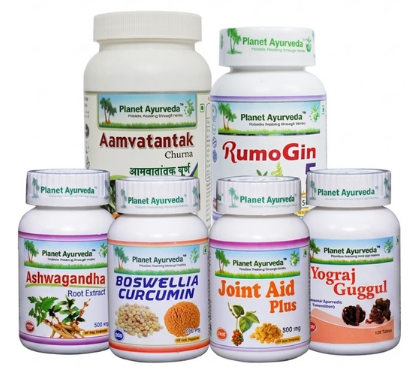

Product Description
1. Boswellia-Curcumin
Boswellia-Curcumin, containing Shallaki and Curcumin, provides Ayurvedic herbal support for inflammatory joint symptoms associated with rheumatoid arthritis. Boswellia is traditionally valued for supporting healthy inflammatory responses and comfortable joint movement, while curcumin contributes antioxidant and inflammation-modulating activity. Their combined action supports joint comfort, flexibility, and physical mobility in individuals experiencing stiffness and inflammatory discomfort. The formulation also supports protection against oxidative stress affecting musculoskeletal tissues. From an Ayurvedic perspective, these ingredients are used to support balanced Vata and Ama, concepts associated with stiffness, pain, and impaired joint function. This makes Boswellia-Curcumin a supportive component of an integrative approach to inflammatory joint health.
Dosage: 2 capsules twice daily with warm water, after meals.
2. Aamvatantak Churna
Aamvatantak Churna, containing Ashwagandha (Withania somnifera), Methi (Trigonella foenum-graecum), Suranjan (Colchicum luteum), Gorakhmundi (Sphaeranthus indicus), Haridra (Curcuma longa), and Sonth (Zingiber officinale), is formulated to support inflammatory joint and musculoskeletal symptoms associated with Amavata. Ashwagandha supports strength and tissue nourishment, while Haridra and Sonth provide antioxidant and inflammation-modulating properties. Methi contributes nutritional and metabolic support, while Suranjan and Gorakhmundi are traditionally used in Ayurvedic joint-care formulations. The combination supports comfortable movement, joint flexibility, and reduction of stiffness associated with inflammatory conditions. Its Deepana-Pachana action is traditionally used to support digestion and metabolic processing of Ama. Thus, Aamvatantak Churna provides a multi-herbal approach to maintaining joint function and musculoskeletal comfort.
Dosage: 1 teaspoonful twice daily with warm water, before meals.
3. Ashwagandha Capsules
Ashwagandha Capsules, containing Withania somnifera, provide supportive care for individuals experiencing weakness, fatigue, and reduced physical resilience alongside chronic inflammatory joint symptoms. Ashwagandha is traditionally classified as a Rasayana and Balya herb, supporting strength, endurance, and healthy muscle function. Its bioactive constituents, particularly withanolides, have demonstrated antioxidant and inflammation-modulating activity in experimental research. These properties support overall musculoskeletal resilience when chronic joint symptoms interfere with physical activity. Ashwagandha also supports stress adaptation and general well-being, which are relevant during prolonged inflammatory illness. In Ayurveda, its Vata-shamaka properties are associated with maintaining healthy movement and tissue strength.
Dosage: 2 capsules twice daily with warm water, after meals.
4. Joint Aid Plus
Joint Aid Plus, containing Nirgundi (Vitex negundo), Shallaki (Boswellia serrata), Guggul (Commiphora mukul), Sonth (Zingiber officinale), and Ashwagandha (Withania somnifera), provides comprehensive herbal support for joint stiffness, discomfort, and restricted mobility. Nirgundi and Shallaki are traditionally used in Ayurvedic joint-care practices for supporting comfortable movement and balanced inflammatory responses. Guggul contributes traditional support for healthy metabolism and joint function, while Sonth provides warming digestive and musculoskeletal support. Ashwagandha complements the formulation by supporting muscle strength and physical resilience. Together, these ingredients promote joint flexibility and comfort during routine movement. From an Ayurvedic perspective, the combination supports Vata balance and healthy functioning of the musculoskeletal tissues.
Dosage: 2 capsules twice daily with warm water, after meals.
5. RumoGin 5 Capsules
RumoGin 5 Capsules, containing Haridra (Curcuma longa), Sonth (Zingiber officinale), Shallaki (Boswellia serrata), Maricha (Piper nigrum), and Pippali (Piper longum), provides multi-herbal support for inflammatory joint discomfort and stiffness. Haridra and Shallaki contribute antioxidant and inflammation-modulating properties, while Sonth supports digestion and comfortable musculoskeletal function. Maricha and Pippali are traditionally valued for Deepana-Pachana activity and are also used to support the bioavailability and utilisation of other herbal ingredients. The combination is therefore directed toward joint comfort, mobility, and healthy inflammatory balance. In Ayurvedic terms, these herbs support management of Ama-Vata–associated stiffness and discomfort. RumoGin 5 consequently provides targeted herbal support for maintaining comfortable movement in inflammatory joint conditions.
Dosage: 1 capsule twice daily with warm water, after meals.
6. Yograj Guggul
Yograj Guggul, containing Commiphora mukul, Cyperus rotundus, Plumbago zeylanica, Emblica officinalis, Terminalia bellirica, Terminalia chebula, and several other Ayurvedic ingredients, is traditionally used for disorders involving Vata-associated musculoskeletal discomfort and stiffness. Guggul supports healthy inflammatory balance and joint function, while Plumbago and the digestive herbs contribute Deepana-Pachana activity. Haritaki, Bibhitaki, and Amalaki provide antioxidant and tissue-supportive properties. The formulation is traditionally valued for supporting flexibility and comfortable movement when stiffness affects the joints and muscles. Its broader Ayurvedic action focuses on balancing aggravated Vata and supporting the proper metabolism of Ama (toxins). Yograj Guggul therefore serves as a traditional supportive formulation for maintaining musculoskeletal function and joint comfort.
Dosage: 2 tablets twice daily with warm water, after meals.
Conclusion
Upadacitinib represents an important advancement in the treatment of rheumatoid arthritis by selectively targeting JAK1-dependent intracellular signalling. By reducing multiple cytokine-mediated inflammatory pathways, it can improve joint symptoms, physical function, patient-reported outcomes, and disease activity in patients with active RA, including those who have responded inadequately to other DMARDs. Clinical evidence demonstrates that these benefits can persist over several years. At the same time, JAK1 inhibition modifies immune pathways that are important for normal host defence, making safety screening and ongoing monitoring essential. Serious infections, herpes zoster, cardiovascular events, thrombosis, malignancy, and laboratory abnormalities must be considered during treatment. Upadacitinib should therefore be viewed not simply as an “inflammation switch,” but as a powerful targeted DMARD whose benefits depend on appropriate patient selection and responsible monitoring. From an Ayurvedic viewpoint, RA can be explored through the framework of Amavata and Vata-Ama interaction, but this traditional model should complement rather than replace evidence-based rheumatological management.

Dr. Vikram Chauhan
https://www.planetayurveda.comDr. Vikram Chauhan (MD - Ayurveda) is a Globally Renowned Ayurveda Physician with Expertise of more than 25 Years. He is the CEO & Founder of http://www.PlanetAyurveda.com, a leading Ayurveda Brand, Manufacturing, and Export Company with a Chain of Clinics and Branches in the US, Europe, Africa, Southeast Asia, India, and other parts of the World. He is also an Ayurveda Author who has written Books on Ayurveda, translated into Many European Languages. One of his Books is "Ayurveda – God’s Manual for Healing". He is on a Mission to Spread Ayurveda All Over the Planet through all the Possible Mediums. With his Vast Experience in Herbs and their Applied Uses, he is successfully treating Numerous Patients suffering from Various Ailments with the help of the Purest Herbal Supplements, Diet, and Lifestyle, according to the Principles of Ayurveda. For More Details, visit - www.planetayurveda.com, www.alwaysayurveda.com
View more posts from this author